




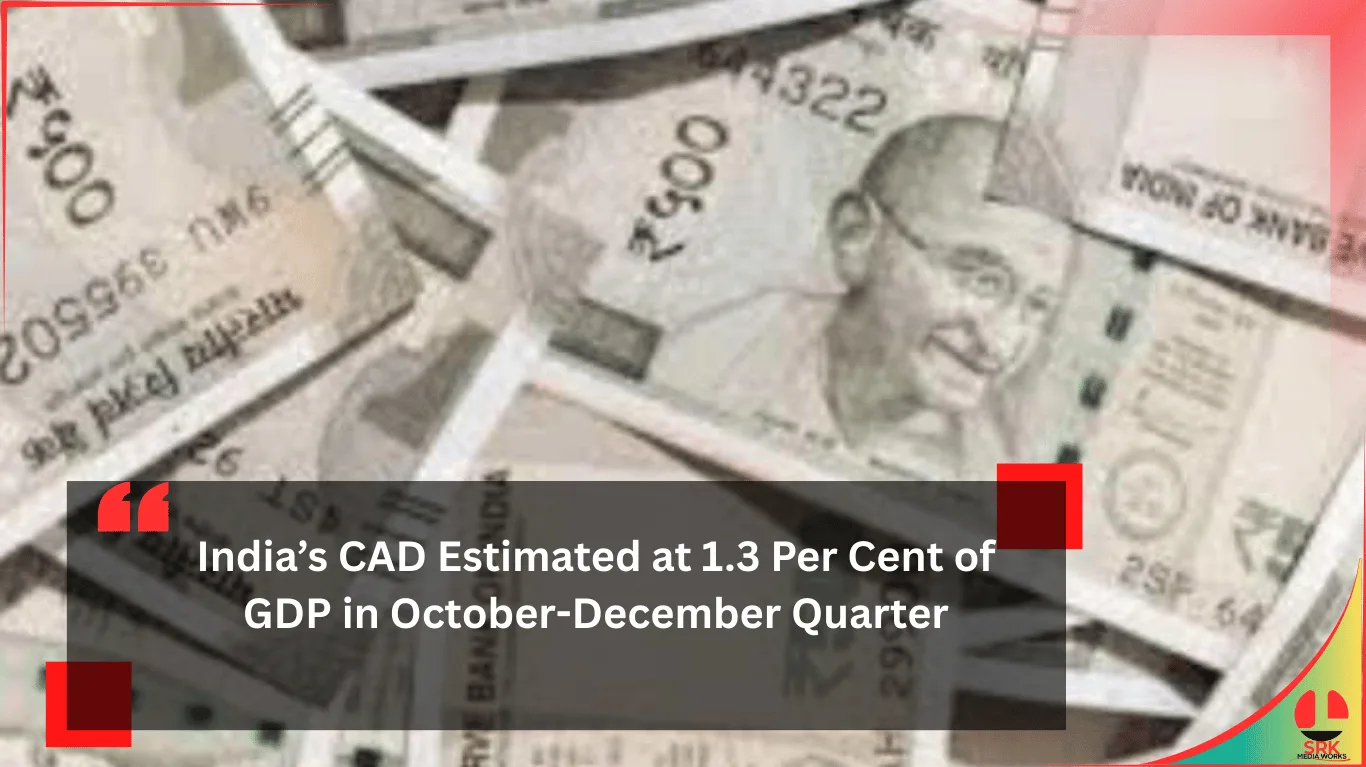
India’s Current Account Deficit (CAD) for the October-December quarter of FY2025-26 has been estimated at 1.3 per cent of GDP, reflecting a moderate gap between the country’s imports and exports of goods, services, and capital flows. The figure highlights both challenges and resilience in India’s external sector amid global uncertainties, fluctuating oil prices, and volatile capital markets.
Context of the Estimate
The CAD is a critical indicator of a nation’s economic health, representing the difference between foreign exchange inflows and outflows. For India, the October-December quarter showed a manageable deficit, thanks to strong service exports and remittances, even as merchandise imports remained high due to energy and gold demand.
Key Highlights
- CAD at 1.3% of GDP: Reflects moderate external imbalance.
- Merchandise Trade Deficit: Driven by oil and gold imports.
- Service Exports: IT and business services provided strong inflows.
- Remittances: Continued to support foreign exchange reserves.
- Capital Flows: Portfolio investments remained volatile amid global uncertainty.
Comparative Analysis of India’s CAD Trends
| Quarter/Year | CAD (% of GDP) | Key Drivers | Policy Response |
|---|---|---|---|
| Q2 FY2025-26 | 1.0% | Lower oil prices, strong services | RBI maintained forex reserves |
| Q3 FY2025-26 | 1.3% | Higher imports, steady remittances | Government monitoring trade balance |
| Q4 FY2024-25 | 1.7% | Global slowdown, weak exports | Fiscal support for exporters |
| Q1 FY2024-25 | 0.9% | Strong IT exports, lower gold demand | Stable monetary stance |
Pivot Analysis of Sentiment
| Sentiment Category | Impact on Economy | Impact on Policy | Impact on Citizens |
|---|---|---|---|
| Investor Confidence | Moderate – CAD manageable | Encourages stable inflows | Reassures markets |
| Public Perception | Neutral – deficit seen as routine | Government seen as cautious | Citizens unaffected directly |
| Media Coverage | Extensive – highlights CAD trends | Balanced – focus on RBI’s role | Keeps economic debate alive |
| Policy Strategy | Encourages diversification | Push for export promotion | Indirect impact on inflation |
Why This Matters
The CAD figure matters because:
- Economic Stability: Reflects India’s ability to manage external imbalances.
- Policy Planning: Guides RBI and government in managing reserves and trade.
- Investor Confidence: Signals resilience amid global volatility.
- Global Positioning: Highlights India’s role as a major emerging market economy.
Challenges Ahead
- Global Oil Prices: Rising crude costs could widen the deficit.
- Export Competitiveness: Need to diversify beyond IT and services.
- Capital Volatility: Portfolio flows remain sensitive to US interest rates.
- Domestic Demand: Rising gold imports add pressure on CAD.
Opportunities Emerging
- Service Sector Strength: IT and business services continue to drive inflows.
- Remittance Growth: Diaspora contributions remain robust.
- Diversification: Expanding exports in manufacturing and agriculture.
- Policy Innovation: Government initiatives to reduce import dependence.
Broader Implications
India’s CAD trajectory reflects broader realities:
- Global Integration: External balances tied to global trade and finance.
- Resilience: Strong services and remittances cushion merchandise deficits.
- Policy Balance: RBI and government must balance growth with stability.
- Public Narratives: CAD figures shape perceptions of economic health.
Conclusion
India’s CAD at 1.3 per cent of GDP in the October-December quarter underscores a manageable external imbalance amid global uncertainties. While merchandise imports remain high, strong service exports and remittances provide stability. The figure highlights India’s resilience and the importance of continued diversification in exports and prudent policy management.
Disclaimer
This article is a journalistic analysis based on publicly available economic data and financial trends. It does not endorse or oppose any government, institution, or policy. Readers are encouraged to interpret the content as informative coverage and verify facts independently before forming opinions.