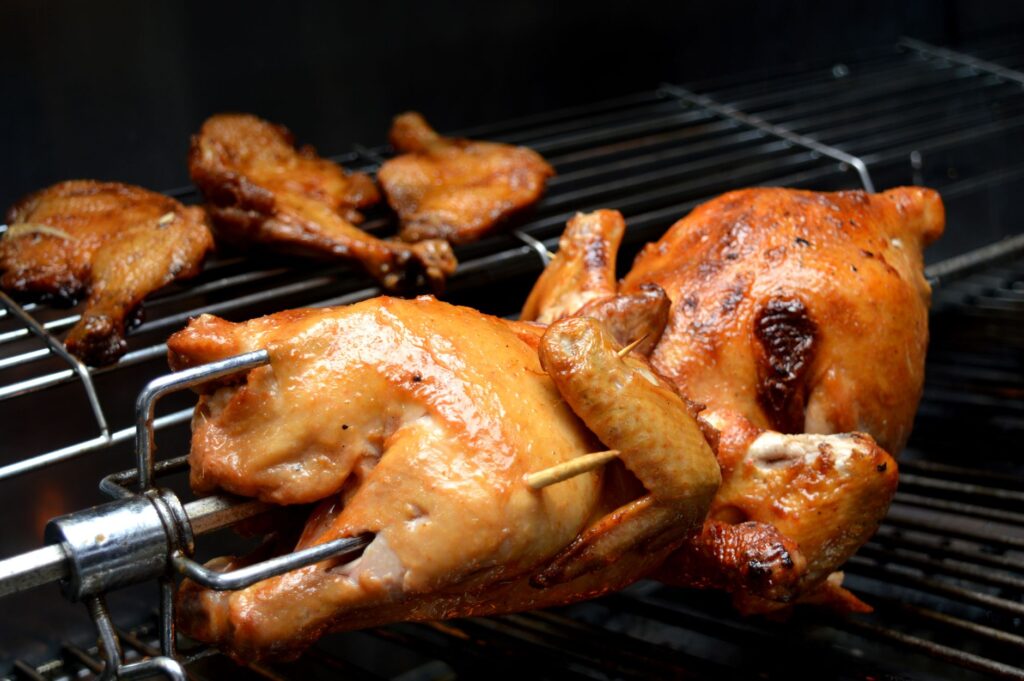

In a major shakeup for warehouse club loyalists, Consumer Reports revealed in its latest national study that Sam’s Club’s Member’s Mark Seasoned Rotisserie Chicken has dethroned Costco’s iconic $4.99 Kirkland Signature bird as the best rotisserie chicken in the industry. The consumer advocacy group evaluated chickens from ten major grocery and big-box retailers across the United States, citing superior flavor, seasoning, and juicy texture as the key reasons for Sam’s Club’s surprise victory. The findings mark a rare competitive setback for Costco’s legendary prepared food division, which has long used its roasted poultry to drive steady foot traffic into its warehouse locations.
The Battle of the Warehouse Loss Leaders
For decades, Costco’s $4.99 rotisserie chicken has maintained a massive, cult-like following among budget-conscious shoppers. The wholesale giant has famously held this price point steady despite years of historic inflation, viewing the chicken—alongside its famous $1.50 hot dog combo—as a core pillar of its value proposition. This strategy relies on the concept of a “loss leader,” where a retailer sells an item at a razor-thin margin to entice customers into the store where they will inevitably purchase higher-margin goods.
However, recent corporate decisions have tested the loyalty of Costco’s customer base. In early 2024, the retailer transitioned from its classic hard plastic clamshell containers to flexible plastic bags for its rotisserie chickens. The change, aimed at reducing plastic waste by an estimated 75%, sparked widespread complaints from shoppers who reported leaks, messy transport, and difficulty carving the bird inside the bag, setting the stage for a rival to capture the spotlight.
How the Contenders Were Judged
To determine which retailer offers the ultimate roasted bird, Consumer Reports designed a rigorous, multi-step testing process that evaluated more than just taste. Researchers purchased between 10 and 13 chickens from each of the 10 selected grocery and warehouse chains. To ensure fairness and account for daily kitchen variations, the purchases were spread across multiple geographic store locations and different shopping trips.
The testing protocol included blind taste tests conducted by sensory experts, precise weighing of each bird to compare actual weight against label claims, and laboratory analysis of sodium levels. Crucially, food safety researchers also screened both the chicken meat and the packaging materials for per- and polyfluoroalkyl substances (PFAS). These toxic “forever chemicals” are commonly associated with food-contact plastics and have raised health concerns globally.
The Results: Flavor Profiles and Surprising Finds
While Consumer Reports did not publish a traditional numerical ranking, it categorized the 10 competitors into two distinct tiers. The top tier featured chickens deemed flavorful enough to serve as a standalone main course, while the second tier contained birds better suited as ingredients for soups, salads, and casseroles. Sam’s Club’s Member’s Mark Seasoned Rotisserie Chicken claimed the ultimate crown in the premium category, with tasters praising its robust seasoning, balanced flavor, and consistently moist texture.
Costco’s Kirkland Signature bird also secured a spot in the top tier, but it fell short of the top honor due to consistency issues. Reviewers noted that while some Costco samples were excellent, others suffered from uneven seasoning and dry patches. Joining Sam’s Club and Costco in the elite category were regional supermarket giants Wegmans, Whole Foods Market, Stop & Shop, and Sam’s Club’s parent company, Walmart.
In contrast, several major brands failed to make the cut for standalone dining. BJ’s Wholesale Club, Hannaford, ShopRite, and upscale grocer The Fresh Market were relegated to the second tier. Tasters found these offerings lacked the depth of flavor or moisture required to anchor a meal on their own, suggesting they are best used as shortcuts for shredded chicken recipes.
Behind the Data: Sodium, Weight, and Safety
Beyond flavor, the scientific testing yielded highly encouraging data regarding food safety. Consumer Reports confirmed that no PFAS chemicals were detected in any of the meat or packaging samples tested across all ten retailers. This finding offers peace of mind to families who rely on these convenient, pre-cooked meals as a weekly dinner staple.
The study also revealed that shoppers are often getting more meat than they pay for. Many of the tested chickens weighed significantly more than the net weight listed on their packaging labels. Whole Foods Market emerged as the most generous retailer in this regard, with its rotisserie chickens averaging about a full pound heavier than advertised, effectively lowering the actual cost per pound for consumers.
However, the report issued a warning regarding nutritional content, specifically sodium. To keep the meat juicy under intense supermarket heat lamps, almost all retailers inject their chickens with a saltwater brine. This process significantly inflates sodium levels, making the chickens a less ideal option for individuals monitoring their cardiovascular health.
Market Implications and What to Watch Next
This sudden shift in the rotisserie chicken hierarchy could have tangible implications for the fierce membership war between Costco and Sam’s Club. As both warehouse giants raise membership fees and vie for suburban household budgets, Sam’s Club now possesses a powerful, independent quality credential to leverage in its marketing campaigns. The victory proves that Sam’s Club’s ongoing efforts to premiumize its Member’s Mark private label are yielding measurable results.
Industry analysts will be watching closely to see how Costco responds to this rare blow to its culinary reputation. It remains to be seen whether the company will adjust its seasoning formulas to address the consistency issues highlighted by Consumer Reports, or if it will reconsider its controversial packaging bags in response to ongoing customer feedback.
Furthermore, as grocery price inflation continues to squeeze household budgets, the battle over low-cost prepared food staples is expected to intensify. Supermarket chains in the lower tier will likely face pressure to reformulate their brines and roasting techniques to prevent losing budget-conscious convenience shoppers to the warehouse clubs. The ongoing evolution of the rotisserie chicken market will serve as a key indicator of how major retailers balance cost, convenience, and quality in a highly competitive economic landscape.