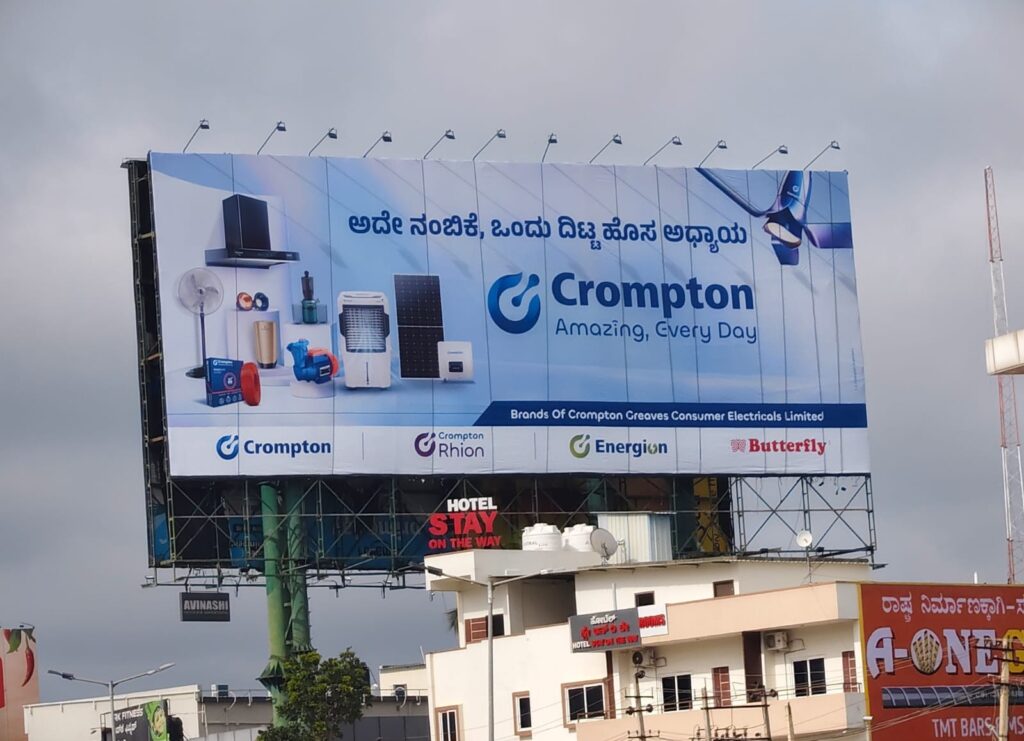

How do you make a new brand identity part of everyday spaces where consumers can encounter it? Crompton Greaves Consumer Electricals Ltd. is bringing its latest brand transformation into the everyday environments of consumers as part of its wider Master Brand Launch.
 |
Crompton’s Master Brand Refresh – OOH Campaign
The OOH campaign is part of Crompton’s broader marketing rollout, which includes Print and Digital and introduces the brand’s new visual identity and the tagline “Amazing, Every Day.” The new identity reflects Crompton’s evolution into an innovation-led, consumer-centric business. Through the integrated campaign, Crompton aims to build awareness of the new identity, broaden awareness of its product range and drive consideration among a wider consumer audience.
OOH plays a critical role in complementing reach-building media by bringing the brand into the everyday environments where consumers spend time. As part of an integrated media approach, it helps reinforce the new brand identity and promise beyond traditional touchpoints, building familiarity and strengthening consideration for the brand. For Crompton, the OOH campaign extends the reach of the Master Brand Launch into high-footfall locations, creating a consistent brand presence across the consumer journey.
Across the four markets – Mumbai, Bengaluru, Chennai and Delhi NCR – the campaign spans premium billboards, transit hubs, key arterial roads and high-footfall urban locations, bringing the new Crompton identity to prominent consumer touchpoints.
The refreshed visual identity has been adapted across multiple outdoor formats, including airports and buses, using Crompton’s new colour palette, visual system and Cephyr – Crompton Greaves Consumer Electricals’ new logo to create a distinctive and recognisable presence.
Commenting on the campaign, Tanmay Prusty, Chief Marketing Officer, Crompton Greaves Consumer Electricals Ltd., said, “A brand identity becomes meaningful when consumers begin to recognise it in the spaces they encounter as part of their everyday lives. That is why OOH is an important part of our Master Brand Launch. By placing the refreshed Crompton identity across high-visibility locations and transit environments, we are able to reach consumers at multiple points in their daily journeys and build repeated exposure to the new brand expression. The campaign is designed to strengthen familiarity and recall while bringing the refreshed Crompton closer to consumers across our key markets.”
Launched in mid-August for a 30-day period, the campaign forms part of Crompton’s wider Master Brand Launch.
About Crompton
With a brand legacy of over 85 years, Crompton Greaves Consumer Electricals Ltd. is India’s market leader in the category of fans and residential pumps. Over the years, the organization has continuously strived to produce a range of innovative products that cater to the modern consumer including superior quality and high-performance fans, pumps, lighting solutions, and a range of other categories like water heaters; air coolers; small kitchen appliances like mixer grinders, air fryers, OTG, electric kettles etc; other home appliances like irons & built-in kitchen appliances. The company has further invested in brand and innovation to not only better understand and meet consumer needs but to also help drive energy efficiency. The consumer business also has a well-established and organized distribution network driven by a strong dealer base across the country offering a wide service network and robust after-sales service to its customers. Beyond its consumer portfolio, Crompton also has a robust B2B presence in the Lighting segment, delivering advanced and energy-efficient solutions for commercial and industrial applications. In 2025, Crompton became the first lighting company to receive the GreenPro certification for its B2B lighting solution, reaffirming its commitment to sustainability and innovation. Strengthening its foothold in the renewable energy space, the company has forayed into solar rooftops—representing a significant step forward in its contribution to India’s evolving clean energy landscape. With solar solutions spanning lighting, pumps, and rooftops, Crompton continues to lead as a responsible and future-ready brand in sustainable energy.
The company’s consistent dedication to developing energy-efficient products has led to significant recognition. It has been honored with three prestigious National Energy Consumer Awards (NECA) by BEE, Ministry of Power. The recent award was presented by the Hon’ble President of India, Smt. Droupadi Murmu for the company’s storage water heater in 2023. In 2019, the brand won in two categories: Ceiling Fans and LED Bulbs. Additionally, it was recognized as one of India’s Best Managed Companies 2022 by Deloitte Private and listed among ‘India’s Top 500 Companies 2022’ by Dun & Bradstreet India. The company has also been featured in Brand Top 75 most valuable Indian brands list for 2020 released by WPP and Kantar. Furthermore, Crompton was also recognized as the Brand of the Decade 2021 by Herald Global and BARC Asia in the Consumer Electrical category.