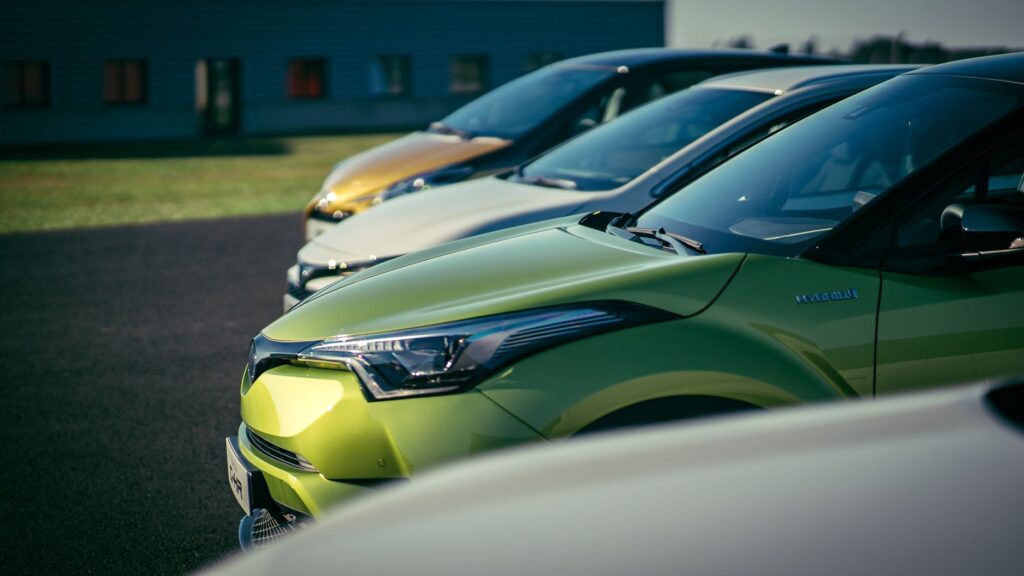

In early 2024, three major Asian auto manufacturing groups—Toyota, Honda, and Hyundai-Kia—are capturing the vast majority of the rapidly expanding U.S. hybrid electric vehicle market. American consumers across the country are pivoting toward hybrid technology as a pragmatic middle ground between traditional internal combustion engines and fully electric vehicles. Driven by high interest rates, persistent inflation, and charging infrastructure concerns, buyers are seeking fuel efficiency without the range anxiety associated with pure battery-electric models.
The Shift in Consumer Demand
For the past three years, the auto industry concentrated its capital and marketing on a rapid transition toward zero-emission electric vehicles (EVs). Federal tax incentives and regulatory mandates accelerated this push across North America. However, consumer enthusiasm for pure EVs hit a speed bump in late 2023 as early adopters finished buying and mainstream shoppers voiced hesitancy over high purchase prices and spotty public charging networks.
Hybrid vehicles have filled this market vacuum rapidly. By combining a conventional gasoline engine with an electric motor and a self-charging battery, hybrids deliver significantly higher miles per gallon without requiring changes to daily driving habits. Industry data indicates that hybrid vehicle sales in the United States grew over 50 percent year-over-year in late 2023 and early 2024, far outpacing the growth rate of fully electric alternatives.
Early Investments Pay Off for Asian Giants
Toyota Motor Corporation stands as the undisputed titan of this sector. Having pioneered mass-market hybrid technology with the Prius more than two decades ago, the Japanese giant maintained its hybrid development even as rivals pledged all-electric futures. Toyota currently offers hybrid options across almost its entire portfolio, including high-volume models like the RAV4, Camry, and Highlander, allowing it to capture nearly half of all U.S. hybrid sales.
Honda Motor Company has executed a similar strategy by integrating its two-motor hybrid system directly into core high-volume trim levels rather than positioning them as niche offerings. Hybrid variants now account for roughly 50 percent of all CR-V and Accord sales in North America. This deliberate integration has streamlined production while offering consumers higher fuel economy on recognizable nameplates.
South Korea’s Hyundai Motor Group, which includes the Kia brand, rounds out the dominant trio. Hyundai and Kia rapidly scaled up their hybrid offerings by developing flexible platform architectures that accommodate gasoline, hybrid, plug-in hybrid, and fully electric powertrains. Models like the Hyundai Tucson Hybrid and Kia Sportage Hybrid have drawn budget-conscious buyers away from domestic brands by providing advanced technological features at competitive price points.
Domestic Automakers Catch Up After Strategic Missteps
Detroit automakers find themselves largely sidelined in the current hybrid boom due to previous strategic pivots. General Motors largely abandoned traditional non-plug-in hybrids in North America years ago to concentrate resources entirely on its Ultium electric vehicle platform. Similarly, European legacy automakers focused heavily on diesel alternatives historically and later pivoted directly to luxury battery-electric platforms.
Ford Motor Company remains the primary American exception, benefiting from hybrid versions of its Maverick compact pickup and F-150 truck. Ford management recently announced plans to quadruple its hybrid sales over the next five years, acknowledging that mainstream adoption of electrified transport will take longer than initially projected.
Market Data Highlights the Dominance
Data from automotive research firm Cox Automotive reveals that hybrid vehicles accounted for roughly 8.3 percent of all U.S. new-vehicle sales in late 2023, totaling over one million units annually for the first time. Combined sales from Toyota, Honda, and Hyundai-Kia represent more than 75 percent of total sales in the non-plug-in hybrid category.
Edmunds, an auto research platform, reports that the average hybrid vehicle sold in under 25 days on dealership lots in early 2024. In contrast, pure battery-electric vehicles averaged over 70 days on dealer lots during the same period, highlighting a sharp divergence in consumer demand velocity.
Strategic Pivots and What to Watch Next
The current landscape is forcing a broader strategic shift across the global automotive sector. General Motors recently announced plans to reintroduce plug-in hybrid vehicles to its North American lineup to comply with tightening federal emissions rules while catering to cautious buyers. Similarly, European manufacturers are reassessing their regional rollout schedules to include more transitional powertrain options through 2030.
Industry analysts will be closely monitoring how supply chain dynamics and changing federal regulations impact this segment over the next 18 months. As the U.S. Environmental Protection Agency finalized stricter tailpipe emissions standards through 2032, the key question remains whether legacy domestic automakers can engineer and launch competitive hybrid platforms quickly enough to erode the strong market lead established by Japanese and Korean manufacturers.