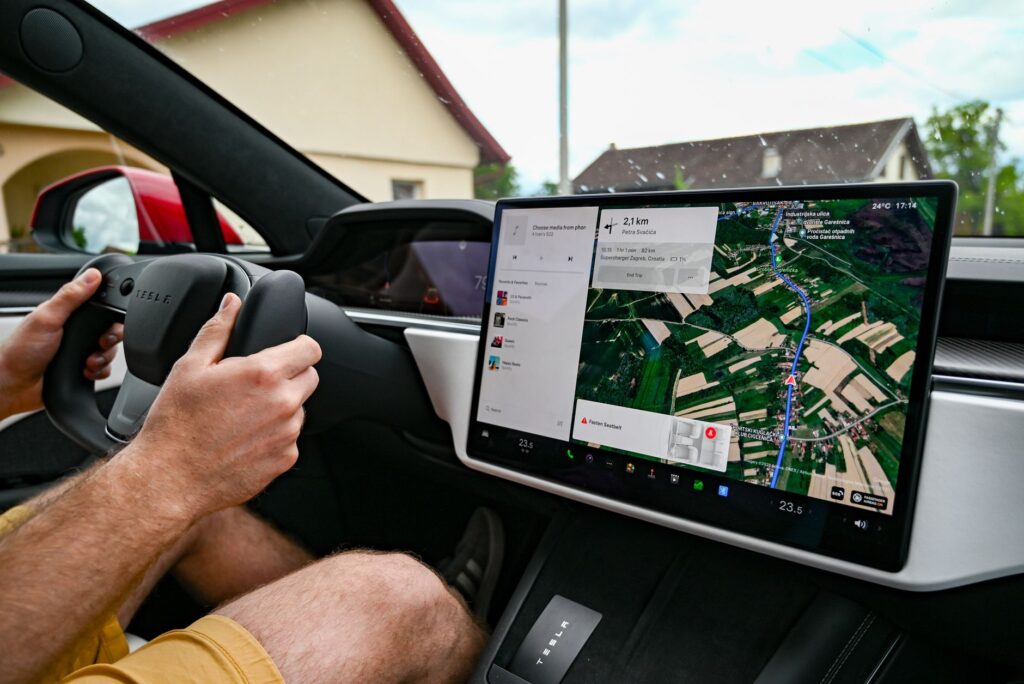

Ford Motor Company announced this week that it will integrate Apple Maps directly into the control architecture of its upcoming line of electric vehicles, marking the first time Apple’s mapping software will actively influence an automaker’s self-driving system. The strategic collaboration, unveiled at Ford’s headquarters in Dearborn, Michigan, aims to enhance hands-free highway driving and battery routing optimization as legacy car manufacturers rush to improve their software capabilities.
A Shift in the Tech-Automotive Dynamic
For years, tech giants and traditional car companies maintained a strictly partitioned relationship. Drivers could mirror their smartphones onto dashboard screens via platforms like Apple CarPlay or Android Auto, but these applications remained isolated from the vehicle’s core mechanical operations.
Ford’s new initiative breaks that barrier. By feeding detailed Apple Maps spatial data directly into Ford’s autonomous driving computing stack, the vehicle can anticipate road geometry, lane splits, elevation changes, and speed limit adjustments with higher precision.
This move comes after months of industry debate surrounding software control inside the cabin. While competitors like General Motors recently phased out Apple CarPlay in favor of built-in native operating systems, Ford is doubling down on consumer software ecosystems to accelerate its autonomous vehicle development.
How Apple Maps Enhances Autonomous Driving
The technical integration allows Ford’s self-driving system—an evolution of its current BlueCruise driver-assistance platform—to utilize Apple’s high-definition mapping data. The system automatically adjusts vehicle speed before sharp curves, manages lane positioning, and identifies optimal charging stops based on real-time traffic and energy consumption forecasts.
Engineers close to the project indicate that Apple Maps will provide real-time lane-level guidance, enabling the car’s central processor to make smoother steering and braking decisions. Additionally, the software communicates directly with the EV battery management system to precondition the battery temperature when approaching a charging station, drastically reducing charge times.
Safety remains a central focus of the rollout. By pairing Ford’s radar and camera sensors with Apple’s constantly updated cloud navigation, the vehicle gains a redundant layer of positioning accuracy during adverse weather conditions or optical obstruction.
Industry Data and Expert Perspectives
Market analysts view the partnership as a crucial bridge between consumer tech usability and automotive engineering. According to data from Gartner, software-defined vehicles are projected to represent over 80% of new passenger vehicle production by 2030, putting immense pressure on traditional automakers to deliver seamless digital experiences.