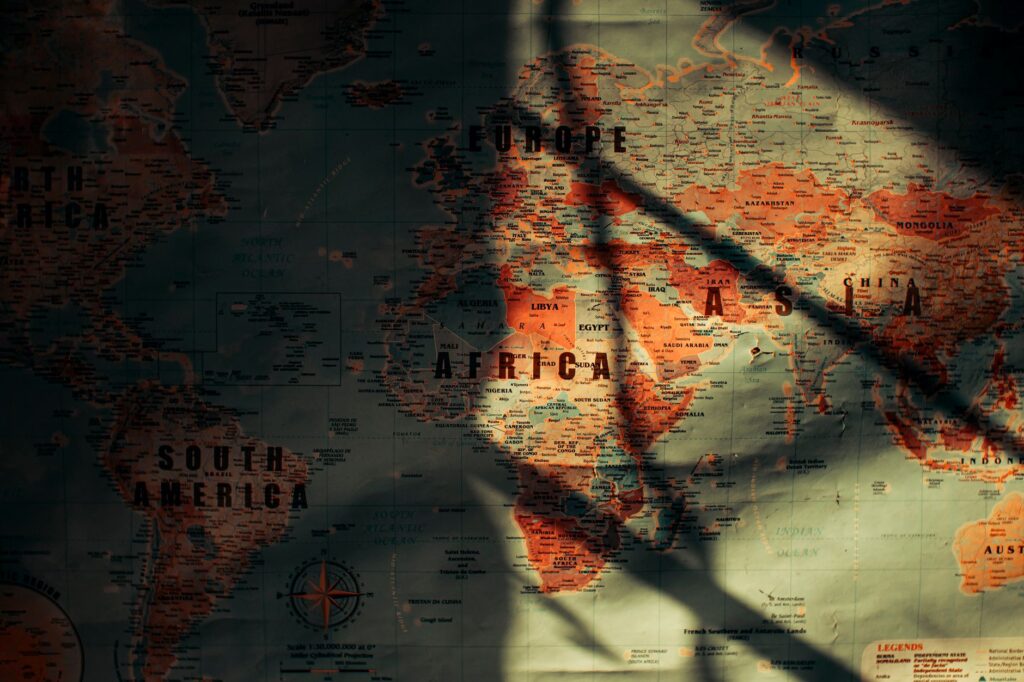

Global cartography is undergoing a significant shift as international governing bodies begin to reevaluate how geographical information is presented to the public. In a major development, the United Nations General Assembly has officially thrown its support behind a concerted effort led by the African Union. This initiative focuses on adopting more precise world maps that properly reflect the actual physical dimensions of continents, particularly addressing long-standing geometric disparities.
Understanding the Mercator Projection
For centuries, classrooms, textbooks, and navigation systems around the globe have relied heavily on the Mercator projection. Developed in the sixteenth century by Flemish cartographer Gerardus Mercator, this method was originally designed to assist sailors with navigation by plotting lines of constant compass bearing as straight segments.
While this projection successfully preserved directional angles, it introduced severe distortions in landmass sizes as they moved further away from the equator. Regions closer to the poles appeared drastically enlarged, whereas areas situated near the equator were rendered significantly smaller than their actual measurements.
Challenging Historical Geographic Distortions
The most prominent victim of this cartographic distortion is the continent of Africa. On traditional Mercator maps, Africa frequently appears comparable in size to Greenland or North America, even though Africa is actually more than fourteen times larger than Greenland and vastly exceeds the land area of North America.
Recognizing the social, educational, and political implications of these persistent visual inaccuracies, the African Union spearheaded a global campaign known as Correct the Map. This movement sought to bring international awareness to how visual representations influence global perceptions of scale, power, and importance.
International Support at the United Nations
The campaign culminated in a historic diplomatic milestone when the United Nations General Assembly formally voted on the matter. A total of 164 countries voted in favor of the resolution supporting accurate geographical representation.
This overwhelming global consensus demonstrates a shared commitment among member states to correct historical biases embedded within standard educational materials and digital mapping tools. Diplomats and policy experts noted that transitioning toward equal-area projections fosters a more equitable and accurate understanding of global geography.
Implications for Education and Global Perception
Experts emphasize that maps are not neutral scientific documents; they shape how societies view the world and its inhabitants. By relying on projections that diminish the visual presence of equatorial regions, generations of students have absorbed inaccurate impressions of global scale.
The adoption of the new resolution encourages educational institutions, mapmakers, and digital software developers to incorporate alternative projections that prioritize true spatial accuracy. Equal-area maps, such as the Gall-Peters projection, present landmasses in their correct relative proportions, offering a faithful depiction of the planet.
Moving Forward with Accurate Mapping Standards
The overwhelming approval by 164 nations marks a turning point in modern cartography. As governments and international organizations begin implementing these updated standards, the global community moves closer to a unified, unbiased visual representation of the earth.
While transitioning away from deeply ingrained mapping habits will take time, the United Nations endorsement provides the momentum necessary for lasting change. Educational curricula and digital applications are expected to gradually adopt these refined geographical standards, ensuring future generations view the world with greater precision and fairness.