





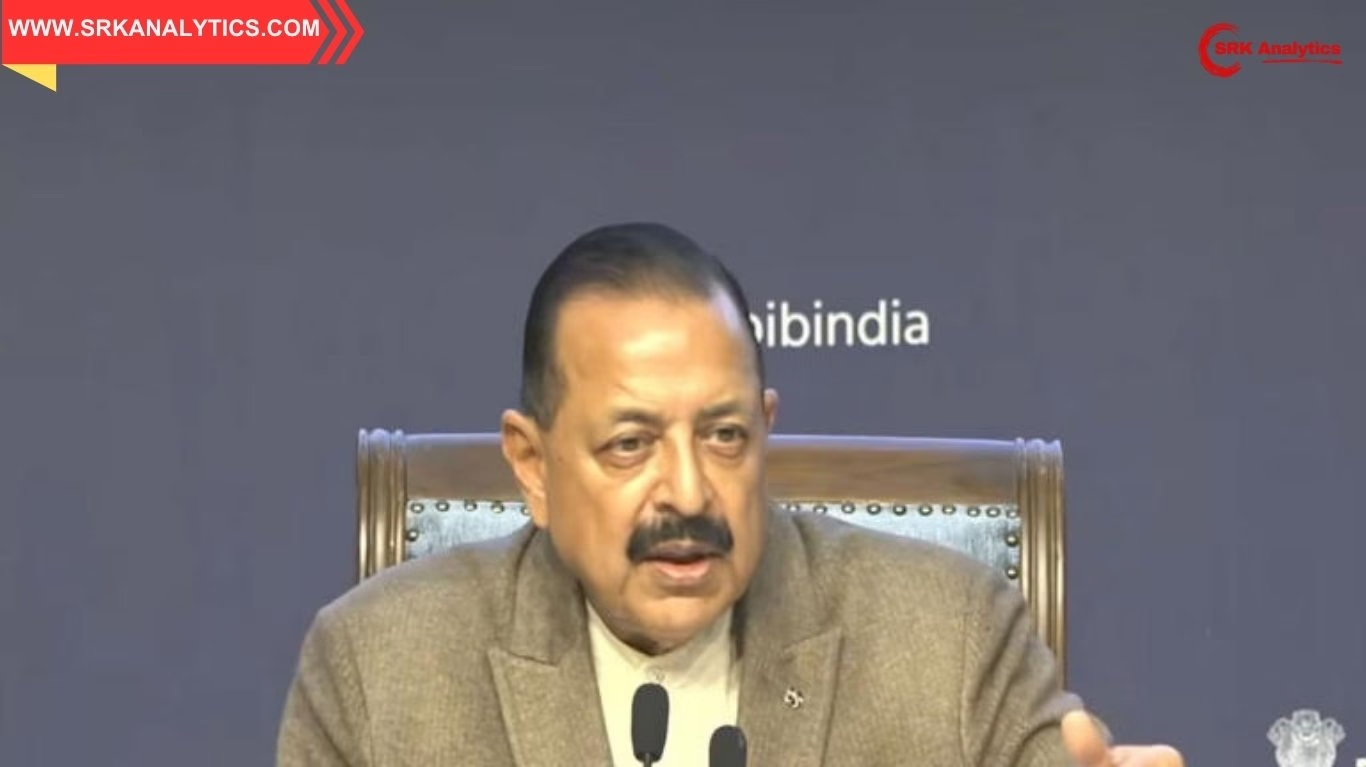
In a landmark announcement that signals a paradigm shift in India’s scientific and industrial policy, Union Minister of State for Science and Technology Dr. Jitendra Singh has described the newly operationalized Rs 1 lakh crore Research, Development, and Innovation (RDI) Fund as a “major shift” in the government’s approach toward private-sector innovation. Speaking at a high-level outreach programme in early 2026, the Minister emphasized that this initiative moves beyond traditional government spending, positioning the private sector as the primary driver of India’s Viksit Bharat 2047 vision.
The RDI Fund, initially announced by Prime Minister Narendra Modi, is designed to catalyze deep-tech research, intellectual property (IP) creation, and large-scale commercialization. Unlike previous models that focused largely on public-funded laboratories, this fund offers unsecured, low-interest loans and equity-based support directly to private enterprises, including startups and established industry leaders.
A Strategic Pivot: From Public Labs to Private Innovation
For decades, India’s R&D expenditure has been dominated by the government. However, Dr. Jitendra Singh noted that globally, the most vibrant innovation ecosystems—such as those powering NASA or Silicon Valley—rely on a synergy where the government acts as a “risk-taker” for the private sector.
“This is not charity or benevolence,” Dr. Singh stated. “It is a strategic catalyst. The RDI Fund acts like the initial push to start a stalled engine. Once the momentum is built, the private sector will scale up and lead India’s charge in frontier technologies.”
Key Features of the RDI Fund
- Massive Corpus: A total of Rs 1 lakh crore to be deployed over a seven-year period.
- Concessional Financing: Long-term loans with interest rates ranging between 2% to 4%, significantly lower than commercial market rates.
- No Collateral: In a global first for public financing of this scale, many of these loans are designed to be unsecured, removing the barrier of asset-heavy requirements for tech-driven startups.
- Extended Moratorium: Repayment tenures extend up to 15 years, allowing sufficient “gestation time” for high-risk, high-impact research to reach the market.
Financial Blueprint and Deployment Strategy
The implementation of the RDI Fund is structured under the Anusandhan National Research Foundation (ANRF). To ensure efficient fund flow, the government has adopted a two-tier management system.
The Multi-Tier Implementation Model
| Level | Responsible Entity | Function |
| Tier I | ANRF (Independent Business Unit) | Custodian of the total corpus and policy formulator. |
| Tier II | Second-Level Fund Managers (SLFMs) | Financial institutions like TDB, BIRAC, NBFCs, and AIFs. |
| Target | Private Industry & Deep-Tech Startups | Execution of R&D projects with TRL-4 (Technology Readiness Level) and above. |
As of February 2026, the Technology Development Board (TDB) and the Biotechnology Industry Research Assistance Council (BIRAC) have already been operationalized as the first set of fund managers. Dr. Singh revealed that the first open call for proposals received a staggering 191 applications, with the majority originating from the private sector, reflecting a high level of industry confidence.
Focus on Sunrise and Strategic Sectors
The RDI Fund is not a “one-size-fits-all” expenditure. It is laser-focused on sectors that are critical to India’s national security, economic self-reliance, and global competitiveness.
- Deep Tech & AI: Development of indigenous AI models, quantum computing, and robotics to reduce dependence on foreign IP.
- Energy Transition: Research into green hydrogen, advanced battery chemistry, and carbon capture technologies.
- Space and Defense: Encouraging private participation in satellite launch vehicles and indigenous defense platforms following the recent 15% hike in defense capital expenditure.
- Bio-Pharma SHAKTI: A dedicated sub-segment with an outlay of Rs 10,000 crore aimed at making India a global hub for biologics and biosimilars.
Comparative Analysis: India vs. Global R&D Expenditure
While the RDI fund is a “major shift,” the Minister acknowledged that India has a long way to catch up with global leaders. Currently, India’s R&D spend stands at approximately 0.7% of GDP, whereas the US and China spend 2.8% and 2.4% respectively. Crucially, in those economies, the private sector contributes over 70% of the total R&D spend; in India, that figure has historically been less than 40%.
| Country | R&D Spend as % of GDP | Private Sector Contribution |
| USA | 2.8% | ~75% |
| China | 2.4% | ~77% |
| India (Current) | 0.7% | ~38% |
| India (Target 2030) | 2.0% | >60% |
The RDI fund is specifically designed to flip this ratio, encouraging Indian corporations to move away from “service-based models” toward “IP-based product models.”
Institutional Reforms and the Role of ANRF
The Anusandhan National Research Foundation (ANRF) serves as the backbone of this transformation. By integrating fragmented research bodies under a single governing board chaired by the Prime Minister, the government aims to remove the “siloed” approach to science.
Dr. Jitendra Singh highlighted that the ANRF is also focusing on University-Industry Collaboration. The RDI fund will support projects that bridge the gap between academic discovery and industrial application. This includes setting up regional innovation clusters in Tier-2 and Tier-3 cities to ensure that the “deep-tech revolution” is not limited to metropolitan hubs like Bengaluru or Hyderabad.
Industry Reaction: A “De-Risking” Move
Industry leaders have welcomed the move, particularly the inclusion of Alternate Investment Funds (AIFs) and Development Finance Institutions (DFIs) as fund managers. Rajat Tandon, President of the Indian Venture and Alternate Capital Association (IVCA), noted that the budget’s focus on execution and the creation of an Infrastructure Risk Guarantee Fund alongside the RDI fund provides a comprehensive “safety net” for long-gestation projects.
However, some experts suggest that for the “major shift” to be truly effective, the government must also introduce weighted tax deductions for R&D expenditure, similar to the erstwhile Section 35(2AB) of the Income Tax Act.
The Path Ahead: Commercialization and Global Leadership
The ultimate goal of the RDI Fund is to ensure that “Made in India” technologies lead the global market. Dr. Jitendra Singh urged Indian innovators to focus on Technology Readiness Levels (TRL). The fund is tailored to support projects from TRL-4 (validation in laboratory environment) to TRL-9 (actual system proven in operational environment).
“India is no longer the India of yesterday,” the Minister concluded. “Our aspiration is to not only participate in the technologies of the future but to lead them.”
With the Union Budget 2026-27 topping up the RDI fund with an additional Rs 20,000 crore, the stage is set for a decade of unprecedented scientific growth. As the first tranche of funds begins to reach deep-tech ventures by the end of this month, the global scientific community is watching closely to see if India’s “private-sector led” model can become a new global benchmark for innovation.
Disclaimer: This news report is for informational purposes only. The financial details and policy statements are based on official government briefings and public records as of early 2026. Readers should consult official government portals and professional financial advisors for specific investment or application guidelines regarding the RDI Fund.