




In a breakthrough that echoes ancient alchemical dreams, a US-based startup has announced that it has successfully converted mercury into gold using nuclear fusion technology. The claim has captured the imagination of scientists, investors, and the public alike, as transmutation of elements—once dismissed as science fiction or medieval fantasy—could now be entering the realm of scientific feasibility.
The Startup and Its Fusion-Based Transmutation
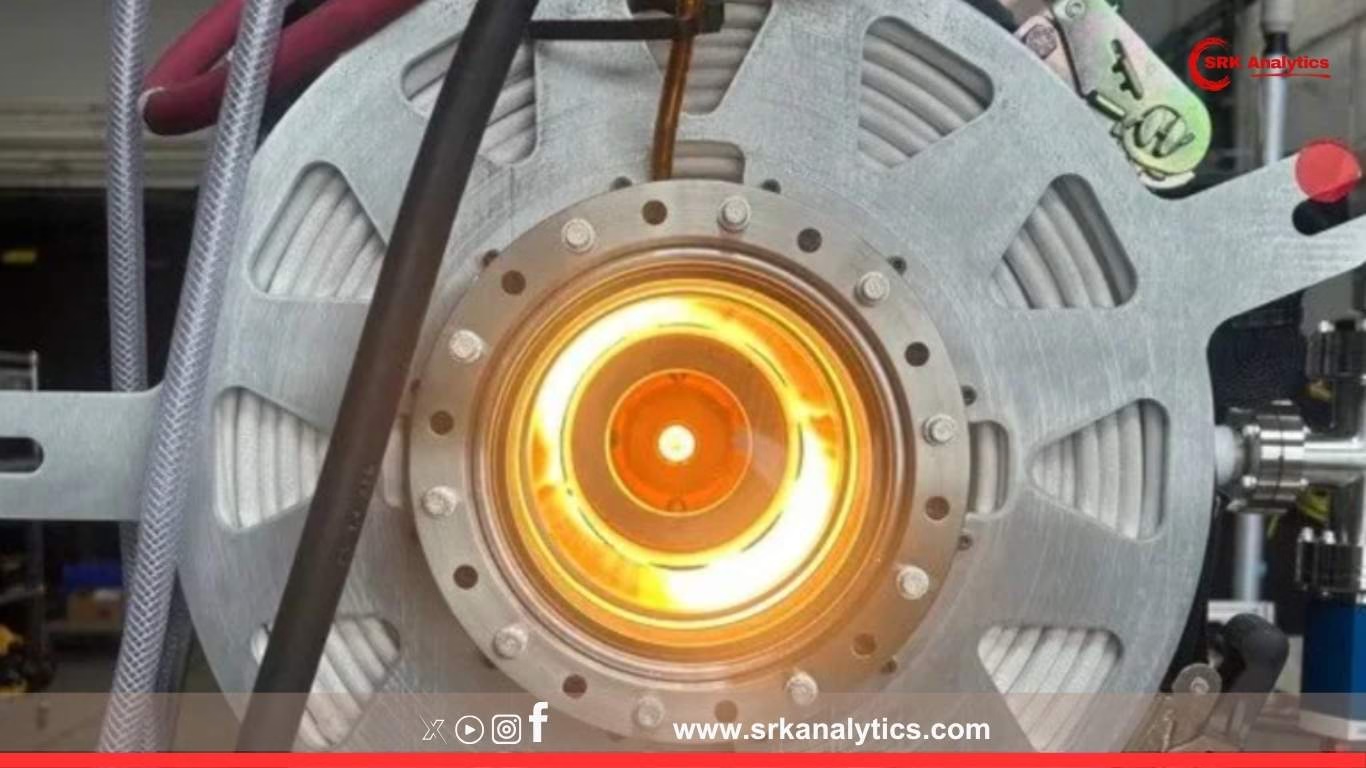
The startup, Auric Fusion Technologies, founded by nuclear physicist Dr. Ethan Wallace and fusion engineer Rebecca Liu, claims it has developed a proprietary micro-fusion reactor capable of inducing elemental transmutation under controlled laboratory conditions. Their process involves:
- Isotopic targeting of mercury nuclei using precision particle beams
- Controlled micro-fusion reaction to alter the proton count
- Stabilisation of the resulting gold isotopes for practical use
In simple terms, the process fuses subatomic particles into mercury atoms, transforming their nuclear structure to match that of gold (atomic number 79).
Scientific Basis of Transmutation
Elemental transmutation is theoretically possible under nuclear reactions. Historically:
- In 1941, scientists at Lawrence Berkeley National Laboratory bombarded mercury with neutrons to produce tiny amounts of gold, but the process was highly energy-intensive and uneconomical.
- Particle accelerators can alter atomic nuclei, but at massive operational costs with negligible output.
Auric Fusion claims its reactor overcomes these limitations with a proprietary low-energy fusion process, enabling practical conversion with net energy feasibility.
Key Claims by Auric Fusion
| Feature | Details |
|---|---|
| Technology | Micro-fusion particle beam transmutation |
| Input Material | Mercury (Hg) isotopes |
| Output Material | Stable gold isotopes |
| Conversion Rate | 1 gram gold per 20 grams mercury (claimed) |
| Energy Cost per gram gold | $3,500 – $4,200 (claimed) |
| Projected Market Launch | Pilot in 2026, commercial by 2028 |
How Does This Compare with Traditional Gold Mining?
| Process | Cost per gram ($) | Environmental Impact | Scalability |
|---|---|---|---|
| Traditional gold mining | $50 – $80 | High (land, water pollution) | High with exploration limits |
| Mercury-to-gold transmutation | $3,500 – $4,200 | Medium (mercury handling risk) | Currently low, future scalable |
While the startup’s claimed cost of production is nearly 50 times traditional mining costs, its potential significance lies in:
- Energy science breakthrough for nuclear physics
- Ability to produce ultra-pure gold for electronics, aerospace, and quantum computing applications where purity trumps cost
- Potential alternative in scenarios where gold mining is geopolitically constrained
Skepticism in the Scientific Community
Despite the startup’s detailed preprint and peer outreach, physicists have urged caution. Dr. Samuel Reiner, nuclear chemist at MIT, commented:
“While nuclear transmutation is theoretically possible, practical fusion-based conversion with net positive energy remains unproven at commercial scale. Extraordinary claims require extraordinary evidence.”
Similarly, Prof. Lata Iyer, particle physicist at Tata Institute of Fundamental Research, noted:
“Even if feasible, mercury-to-gold conversion may pose environmental hazards due to mercury’s toxicity and nuclear waste byproducts.”
Auric Fusion’s Funding and Roadmap
The startup has raised $22 million in seed and Series A funding led by Horizon Ventures and Quantum Capital Partners, with participation from tech billionaires interested in fusion and quantum applications. The company plans:
- Pilot demonstration by Q4 2026 with industrial partners in Japan and South Korea
- Secure patents and regulatory approvals for nuclear material handling and safety
- Commercial micro-reactors by 2028 targeting electronic-grade gold production
Potential Industrial Applications Beyond Jewellery
- Quantum computing: Ultra-pure gold is used in quantum chips and superconducting circuit fabrication.
- Aerospace components: Gold’s conductivity and corrosion resistance are critical for satellite and spacecraft parts.
- Medical devices: High-purity gold is used in stents and nano-delivery systems.
Ethical and Economic Implications
1. Market Disruption Risk
If the technology scales with falling costs, gold prices could face downward pressure, affecting global mining economies reliant on gold exports.
2. Environmental Considerations
While transmutation eliminates mining-related deforestation and tailings, mercury handling poses toxicity risks requiring stringent containment and disposal.
3. Geopolitical Impacts
Gold reserves underpin sovereign wealth and currency stability in several countries. Artificial gold production could reshape macroeconomic strategies if it achieves scale.
Global Reactions
- Financial markets: Gold futures remained stable as investors view commercial viability as distant.
- Mining industry: Mixed reactions with major miners dismissing the tech as “non-economic at scale,” while others monitor it for long-term risk assessment.
- Fusion research community: The claim has rekindled interest in low-energy fusion pathways and potential interdisciplinary breakthroughs.
The Road Ahead
Auric Fusion is currently in talks with the US Department of Energy and the Japanese Atomic Energy Agency for collaborative research. Independent validation of its results by external labs is awaited in Q3 2025. Analysts suggest:
“Even if commercial viability is two decades away, this innovation could redefine materials science, nuclear physics, and industrial economics.”
Conclusion
While the dream of “alchemy turned reality” remains far from everyday practicality, Auric Fusion’s claims mark a potentially historic moment in nuclear research. If validated, the ability to transmute mercury into gold via fusion could not only fulfil a centuries-old human fascination but also create paradigm shifts in resource economics, high-tech manufacturing, and scientific understanding of matter.
Disclaimer
This news content is for informational purposes only. It is not intended as investment advice. Readers are advised to consult scientific experts and financial analysts before making any business, academic, or investment decisions based on this report.