


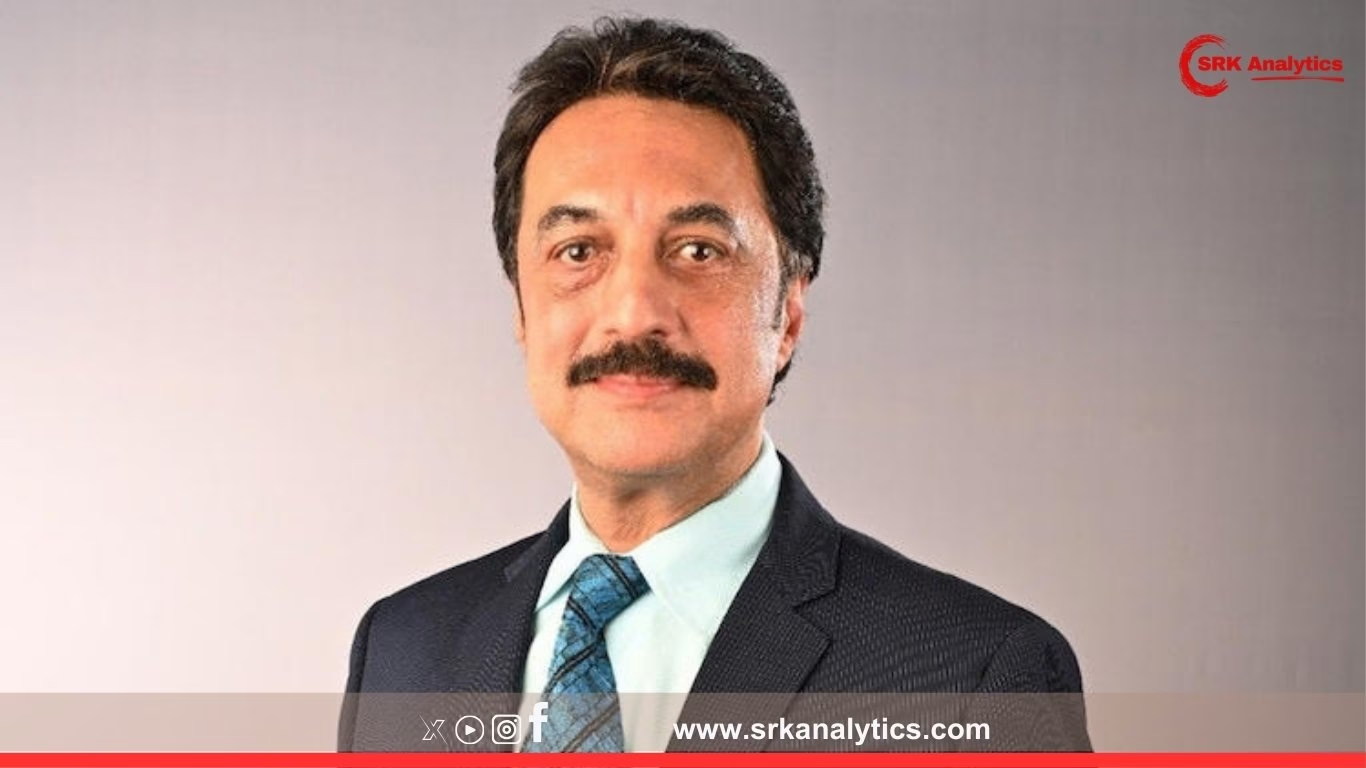
Veteran investor Shankar Sharma has ignited a fierce debate in India’s financial circles by calling the Indian derivatives market a “complete scam,” citing ultra-high trading costs and systemic inefficiencies that disproportionately hurt retail traders. In a post on X (formerly Twitter), Sharma backed options trader Ananda Sarkar’s decision to move capital to the US markets, praising the Chicago Board Options Exchange (CBOE) for its low-cost structure, liquidity, and access to zero-day expiry (0DTE) options.
Sharma’s remarks have struck a chord with thousands of retail traders who feel squeezed by a system that, according to critics, benefits brokers, exchanges, and the government—while leaving individual investors with little to show for their risk and effort.
🧭 Timeline of Events Leading to Sharma’s Outburst
| Date | Event Description | Market Impact |
|---|---|---|
| August 24, 2025 | Ananda Sarkar announces shift to US options trading | Sparks debate on X |
| August 24, 2025 | Shankar Sharma endorses move, calls Indian market a scam | Retail traders rally behind criticism |
| August 25, 2025 | SEBI study reveals 91% retail traders incur losses | Validates concerns over structural flaws |
Sharma’s post read: “Indian derivatives market is a complete scam by way of ultra high costs which eat away returns massively. ONLY BROKERS, EXCHANGES & GOVERNMENT make money. Baki sab, than than gopal. Kya loota in teeno ney…”
📊 Comparative Cost Structure: India vs US Options Trading
| Cost Component | India (Approximate) | US (Approximate via CBOE) |
|---|---|---|
| Brokerage Fee | ₹20 per order | $0.50 per contract |
| GST | 18% on brokerage | None |
| STT/CTT | ₹0.05–₹0.125 per lot | None |
| SEBI Charges | ₹10 per crore | None |
| Stamp Duty | ₹300 per crore | None |
| Exchange Fee | ₹5–₹10 per lot | $0.02–$0.05 per contract |
| Income Tax on Gains | Up to 30% | Zero (if trading from UAE) |
The layered cost structure in India significantly erodes profits, especially for high-frequency and small-margin traders. In contrast, US markets offer streamlined pricing and tax advantages for non-resident traders.
🔍 SEBI Study: Retail Traders Losing Big in Derivatives
A recent SEBI study revealed that 91% of individual traders incurred net losses in the equity derivatives segment in FY25, with aggregate losses widening by 41% to ₹1.05 lakh crore from ₹74,812 crore in FY24.
| Fiscal Year | Net Loss by Retail Traders (₹ crore) | % of Traders Losing |
|---|---|---|
| FY24 | ₹74,812 | 89% |
| FY25 | ₹1,05,000 | 91% |
The findings underscore the systemic imbalance in India’s derivatives market, where institutions and intermediaries profit regardless of retail outcomes.
🧠 Structural Flaws in India’s Derivatives Ecosystem
Critics argue that India’s derivatives market is skewed in favor of institutions, with flawed index construction, excessive leverage, and speculative volumes dominating the landscape.
| Structural Issue | Description | Impact on Retail Traders |
|---|---|---|
| Index Skewness | Bank Nifty dominated by 2 stocks (HDFC, ICICI) | Misleading benchmarks |
| Weekly Expiry Options | High volatility, manipulation risk | Increased losses |
| Lack of 0DTE Options | Limited flexibility for short-term strategies | Reduced tactical advantage |
| Regulatory Arbitrage | Exchanges profit from high volumes | Retail traders bear full risk |
A Moneylife investigation revealed that on expiry days, Bank Nifty options at a single strike price can generate notional volumes exceeding ₹79,000 crore—while actual cash market volumes remain a fraction of that.
📉 Retail Sentiment and Migration to Global Markets
Following Sharma’s remarks, many Indian traders have begun exploring platforms like Interactive Brokers and TD Ameritrade to trade US options. The appeal lies in:
- Lower transaction costs
- Access to 0DTE options
- Better liquidity and tighter spreads
- Tax-free gains when trading from jurisdictions like UAE
| Reason for Migration | Trader Benefit |
|---|---|
| Cost Efficiency | Higher net returns |
| Platform Reliability | Advanced tools and analytics |
| Regulatory Clarity | Transparent fee structures |
| Tax Optimization | Zero income tax in offshore accounts |
Ananda Sarkar, whose post triggered the debate, praised CBOE’s structure and noted that trading from the UAE via Interactive Brokers offers unmatched efficiency.
🧠 Industry Reactions: Mixed Signals from Market Veterans
While Sharma’s comments have resonated with retail traders, some industry veterans have cautioned against blanket criticism. Uday Kotak recently highlighted India’s 80% global market share in index and stock options, calling it a “remarkable achievement”.
| Expert Name | Position on Sharma’s Remarks |
|---|---|
| Shankar Sharma | “Complete scam… only brokers and govt profit” |
| Uday Kotak | “India leads globally in options contracts” |
| Debashis Basu | “Derivatives delusion… flawed indices” |
| SEBI | “Retail losses rising… need for awareness” |
The divergence in views reflects the complexity of India’s derivatives market—where volume growth masks deeper structural issues.
📌 Conclusion
Shankar Sharma’s explosive critique of India’s derivatives market has reignited calls for reform, transparency, and investor protection. As retail traders increasingly explore global alternatives, the onus is on Indian regulators and exchanges to address systemic flaws and restore trust.
Whether this moment leads to meaningful change or further fragmentation remains to be seen. But one thing is clear: the conversation around India’s derivatives market is no longer confined to trading desks—it’s now a national debate.
—
Disclaimer: This article is based on publicly available news reports and official statements as of August 25, 2025. It is intended for informational purposes only and does not constitute financial, legal, or investment advice.