




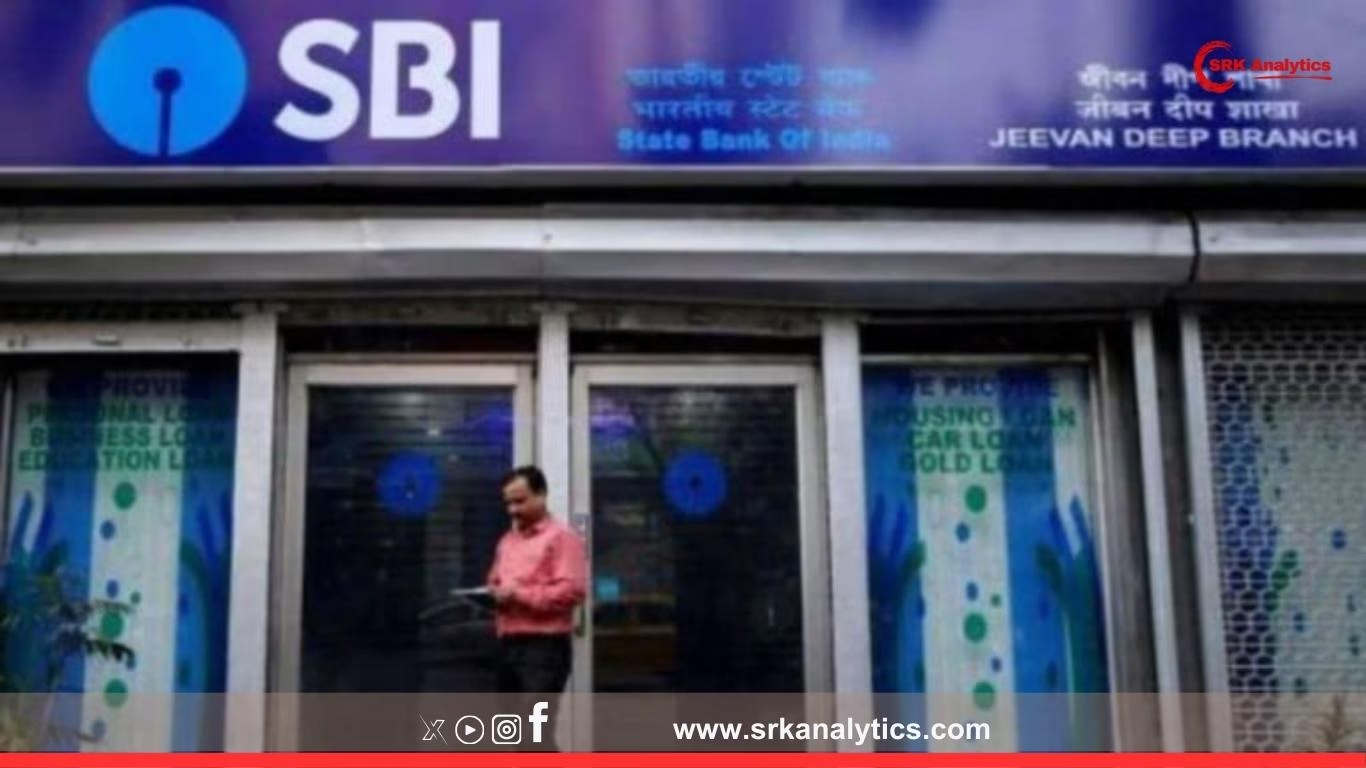
In a significant move that could impact lakhs of borrowers, State Bank of India (SBI), Bank of Baroda (BoB), and Indian Overseas Bank (IOB) have announced a reduction in their Marginal Cost of Funds-based Lending Rate (MCLR) across select tenures. The revision in lending rates is expected to make home loans, car loans, and personal loans cheaper, providing much-needed relief to both retail and corporate borrowers.
This step comes at a time when India’s economy is navigating global uncertainties, inflationary pressures, and evolving interest rate cycles. By reducing MCLR, banks aim to support credit demand and stimulate economic activity.
What is MCLR and Why Does it Matter?
The MCLR (Marginal Cost of Funds-based Lending Rate) is the minimum interest rate at which a bank can lend to borrowers. Introduced by the Reserve Bank of India (RBI) in 2016, MCLR ensures transparency in the calculation of lending rates.
- When MCLR is reduced, borrowers benefit from lower EMIs (Equated Monthly Installments).
- It directly impacts floating rate loans, especially home loans, personal loans, and MSME financing.
- Banks review MCLR monthly, quarterly, or annually, depending on their internal policy.
Thus, any reduction in MCLR is seen as a borrower-friendly move and reflects the bank’s strategy to align with market conditions.
Revised MCLR Rates – SBI, Bank of Baroda, and Indian Overseas Bank
| Tenure | SBI (Revised MCLR %) | Bank of Baroda (Revised MCLR %) | Indian Overseas Bank (Revised MCLR %) | Previous Avg. Rate (%) | Change (%) |
|---|---|---|---|---|---|
| Overnight | 8.00 | 8.10 | 8.15 | 8.25 | -0.10 to -0.15 |
| 1 Month | 8.10 | 8.20 | 8.25 | 8.30 | -0.05 to -0.15 |
| 3 Months | 8.25 | 8.30 | 8.35 | 8.45 | -0.10 |
| 6 Months | 8.30 | 8.35 | 8.40 | 8.50 | -0.10 |
| 1 Year | 8.40 | 8.50 | 8.55 | 8.65 | -0.10 |
| 2 Years | 8.50 | 8.60 | 8.65 | 8.70 | -0.05 to -0.10 |
| 3 Years | 8.60 | 8.65 | 8.70 | 8.75 | -0.05 to -0.10 |
This comparison shows a 0.05% – 0.15% reduction across major tenures, which will have a direct bearing on lending rates for retail borrowers.
Impact on Borrowers
The reduction in MCLR is good news for customers across different segments:
- Home Loan Borrowers – A 0.10% reduction on a ₹50 lakh home loan for 20 years could save borrowers up to ₹5 lakh in total interest payout.
- Car Loans – Vehicle financing will become more affordable, boosting auto sales in the festive season.
- MSMEs – Small businesses that rely on working capital loans linked to MCLR will find relief in reduced borrowing costs.
- Personal Loans – With interest rates marginally reduced, retail credit demand is likely to rise.
Why Banks Reduced MCLR Now
There are several economic and regulatory factors influencing the decision:
- Stable Inflation Outlook: With CPI inflation showing signs of moderation, banks are more confident in reducing lending rates.
- Liquidity Surplus: The banking system is currently flush with liquidity, allowing room for rate reductions.
- Competitive Pressure: Private banks and NBFCs have been aggressive with loan products, prompting PSU banks to respond with rate cuts.
- Growth Push: The government’s emphasis on infrastructure and credit growth requires banks to make borrowing easier.
MCLR vs Repo-Linked Lending Rate (RLLR)
| Parameter | MCLR | Repo-Linked Lending Rate (RLLR) |
|---|---|---|
| Basis of Calculation | Internal factors like cost of funds | Directly linked to RBI Repo Rate |
| Reset Period | Monthly/Quarterly/Annually | Immediately after repo changes |
| Transparency | Moderate | High |
| Impact on Borrowers | Slower transmission of rate changes | Faster transmission |
While MCLR-linked loans still exist, many new borrowers prefer repo-linked loans as they offer quicker transmission of RBI’s monetary policy changes.
Expert Views on Rate Cut
Market experts believe that this reduction in MCLR signals a borrower-friendly trend in India’s banking system.
- Economists say the cut will support credit growth in retail, auto, and MSME segments.
- Banking Analysts note that PSU banks are trying to align with private lenders in terms of competitive pricing.
- Real Estate Sector expects higher home loan demand, especially in urban centers.
Borrower Strategies After the MCLR Cut
- Check Loan Agreement – Borrowers must confirm if their loans are linked to MCLR or RLLR.
- Consider Balance Transfer – If other banks offer lower rates, balance transfer can help reduce EMI burden.
- Opt for Shorter Tenures – Lower interest rates with shorter repayment periods can save significant money.
- Monitor Reset Dates – Borrowers should be aware of their loan reset cycle to benefit from reduced MCLR.
Expected Ripple Effects
- Real Estate Boost – Affordable home loan rates could spur housing demand in Tier-1 and Tier-2 cities.
- Auto Industry Growth – Cheaper vehicle financing may push car and two-wheeler sales upwards.
- MSME Expansion – Easier credit access will empower small businesses to expand operations.
- Overall Economy – Reduced lending rates may accelerate India’s consumption-driven growth story.
Comparative Analysis: PSU vs Private Banks
| Bank Type | Avg. Lending Rate (%) | Avg. Reduction Announced (%) | Borrower Segment Impact |
|---|---|---|---|
| Public Sector Banks (SBI, BoB, IOB) | 8.30 – 8.55 | 0.05 – 0.15 | Home loans, MSMEs |
| Private Banks (HDFC, ICICI, Axis) | 8.40 – 8.70 | 0.00 – 0.05 | Personal loans, corporate loans |
Clearly, PSU banks have taken a more proactive approach in passing rate cuts compared to private sector peers.
Conclusion
The decision by SBI, Bank of Baroda, and Indian Overseas Bank to cut MCLR comes as a relief for borrowers at a time when global economic conditions remain uncertain. By reducing lending rates, these banks have not only increased competitiveness but also provided a positive push to India’s growth trajectory.
With cheaper loans across housing, auto, and MSME segments, credit demand is expected to rise in the coming quarters. For borrowers, this is an ideal time to revisit loan options, consider refinancing, and plan long-term financial goals with reduced EMI pressure.
Disclaimer: The above article is for informational purposes only and should not be considered financial advice. Borrowers and investors are advised to consult their financial advisors before making loan or investment-related decisions.