





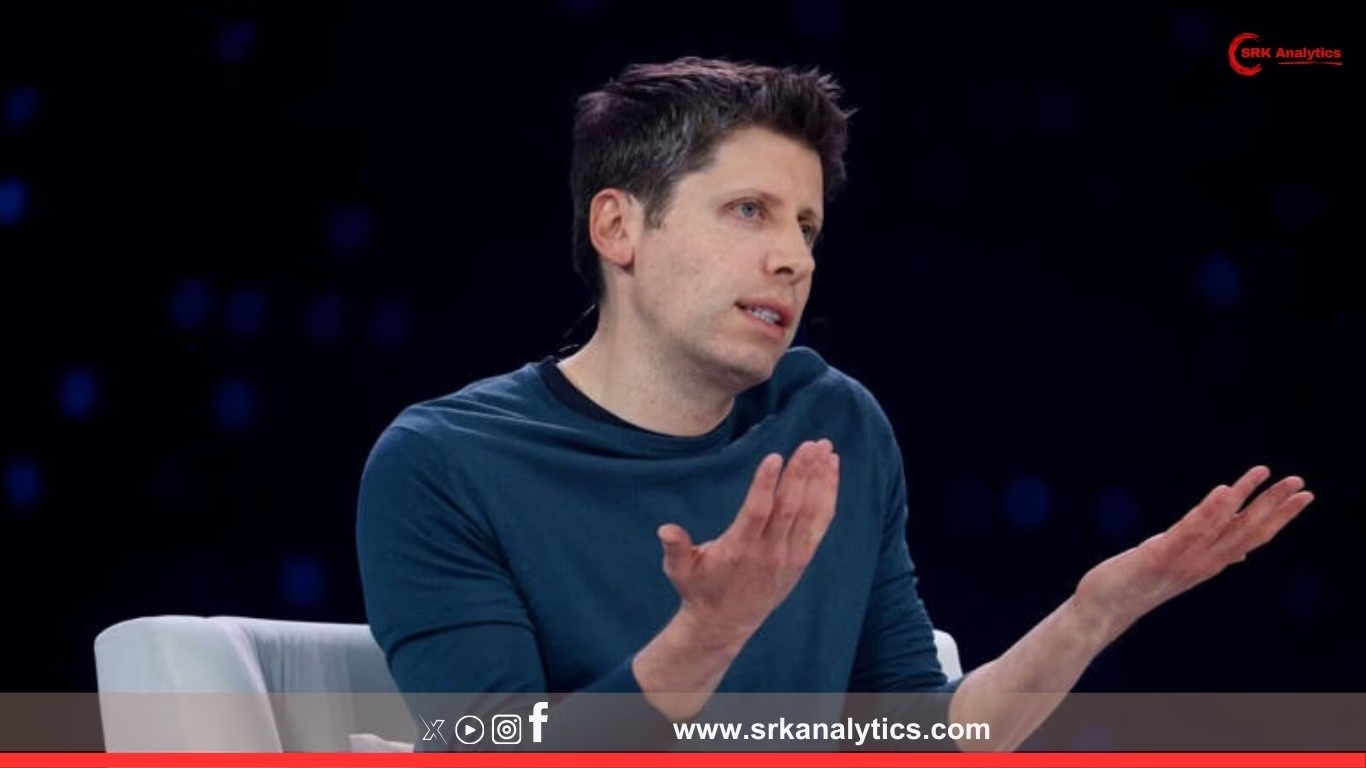
OpenAI CEO Sam Altman has reignited the global debate on artificial intelligence and employment disruption with a bold prediction: several job categories are on the brink of extinction due to rapid AI advancement. Speaking on The Tucker Carlson Show, Altman said he is “confident” that customer service roles and routine programming jobs will be among the first to be replaced by AI systems, triggering widespread reactions from tech leaders, educators, and policymakers.
Altman’s remarks come at a time when AI adoption is accelerating across industries—from finance and healthcare to retail and logistics. While many experts have long speculated about AI’s impact on employment, Altman’s direct assertion adds urgency to the conversation. “I’m confident that a lot of current customer support that happens over a phone or computer, those people will lose their jobs, and that’ll be better done by an AI,” he said.
He further described the transformation as a “punctuated equilibria moment,” suggesting that job displacement will not be gradual but sudden and widespread. “This is going to be a short burst of change, not a slow evolution,” Altman warned.
Jobs Sam Altman Believes Are Most at Risk from AI
| Job Category | Reason for Vulnerability | AI Advantage |
|---|---|---|
| Customer Service Agents | Repetitive tasks, scripted interactions | Natural language processing, 24/7 availability |
| Routine Programmers | Standard coding, low creative input | Code generation, debugging automation |
| Data Entry Clerks | Manual input, low decision-making | OCR, auto-fill, predictive typing |
| Telemarketing Executives | Scripted calls, low emotional nuance | AI voice bots, sentiment analysis |
| Basic Technical Support | Troubleshooting via fixed protocols | AI diagnostics, self-learning systems |
Altman clarified that not all programming roles are at risk. Creative, judgment-based, and design-intensive coding will still require human expertise. However, tasks involving boilerplate code, bug fixes, and system maintenance are increasingly being handled by AI tools like GitHub Copilot and ChatGPT-powered IDEs.
The OpenAI chief also emphasized that roles requiring human empathy, ethics, and emotional intelligence—such as nursing, therapy, and caregiving—are unlikely to be replaced. “Jobs based on human warmth, care, and emotional nuance won’t disappear,” Altman said.
Jobs Altman Considers Safe from AI Disruption
| Job Category | Human-Centric Skills Involved | Reason for Resilience |
|---|---|---|
| Nurses and Caregivers | Empathy, physical presence, judgment | Emotional connection, ethical decisions |
| Psychologists | Listening, emotional analysis | Human trust, nuanced interpretation |
| Teachers | Adaptability, mentorship | Personalized learning, social development |
| Social Workers | Community engagement, crisis response | Cultural sensitivity, moral reasoning |
| Artists and Designers | Creativity, aesthetic judgment | Originality, subjective evaluation |
Altman’s predictions have sparked mixed reactions. While some tech leaders agree that automation is inevitable, others caution against overestimating AI’s capabilities. Gartner, in a recent study, forecasted that by 2027, nearly half of organizations planning to cut support staff due to AI will abandon or scale back those plans due to implementation challenges.
Industry veterans argue that AI systems still struggle with context, emotional nuance, and complex problem-solving. “Replacing human agents entirely is harder than it seems,” said a senior analyst at Forrester Research. “AI can assist, but full replacement is a long road.”
Altman’s comments also carry implications for education and workforce planning. He urged students and professionals to build skills that AI cannot easily replicate—such as design thinking, user experience, systems thinking, and ethical reasoning. “Stay adaptable. Continuous learning and hybrid roles will be more resilient,” he advised.
How Workers Can Future-Proof Their Careers in the Age of AI
| Strategy | Description | Benefit |
|---|---|---|
| Upskill in Human-Centric Areas | Focus on empathy, ethics, creativity | AI-proof skillset |
| Embrace Hybrid Roles | Combine AI tools with human oversight | Increased productivity, relevance |
| Learn Design Thinking | Solve problems with user-centric approaches | Valuable across industries |
| Build Systems Thinking | Understand complex interdependencies | Strategic decision-making |
| Stay Agile and Curious | Adapt to new tools and workflows | Career longevity |
Altman’s forecast is not just a warning—it’s a roadmap. As AI reshapes industries, the workforce must evolve. Governments, educators, and employers are now tasked with preparing citizens for a future where machines handle the mundane, and humans lead with meaning.
The AI revolution is not about replacing people—it’s about redefining roles. Those who embrace change, cultivate irreplaceable skills, and remain open to collaboration with intelligent systems will thrive. As Altman put it, “Build for what AI can’t easily replicate—connection, creativity, judgment—so you don’t lose out as the job market reshapes”.
Disclaimer: This article is based on publicly available interviews, media reports, and expert commentary. It does not reflect any political stance or endorsement. All quotes are attributed to public figures as per coverage. The content is intended for editorial and informational purposes only.