



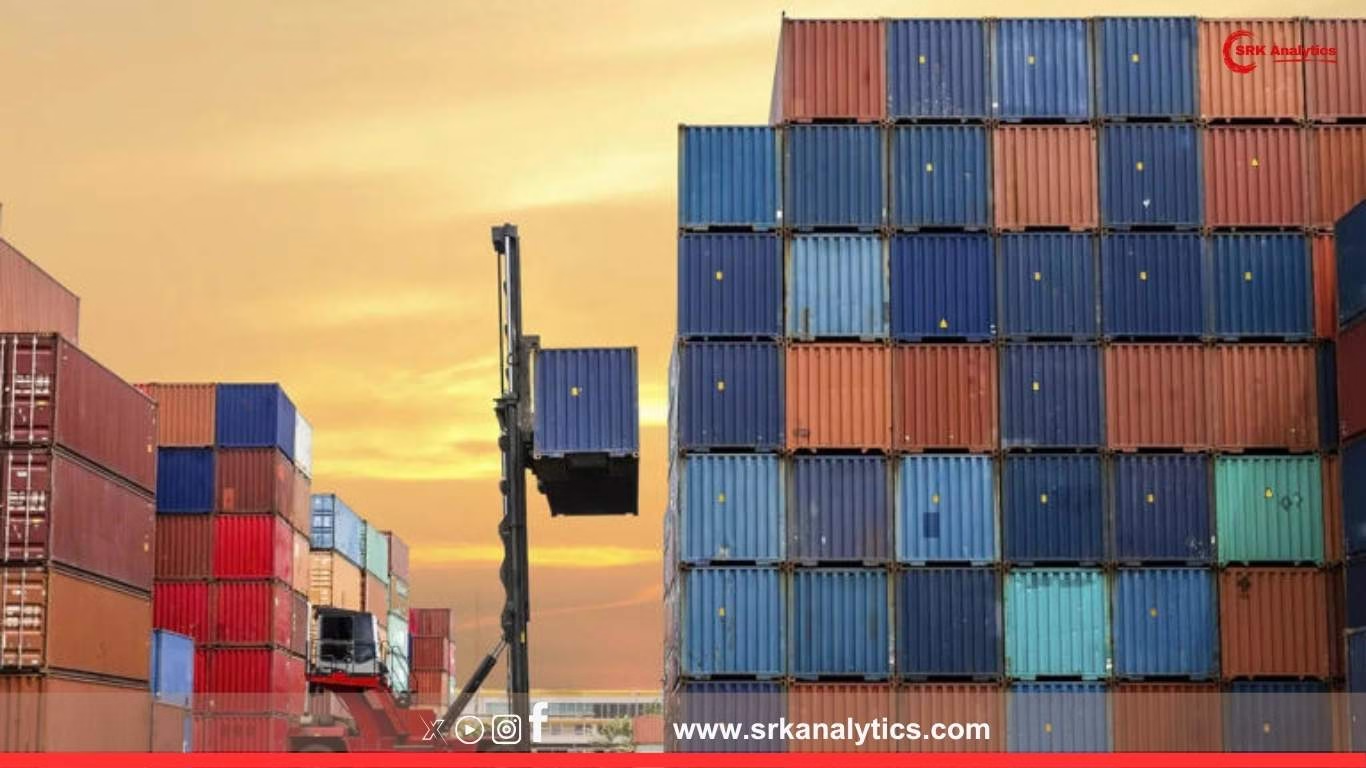
India’s growing emphasis on economic resilience and strategic autonomy has sparked a major policy shift aimed at rebalancing its trade equation with China. While Beijing continues to be New Delhi’s largest source of imports, the Indian government, industry stakeholders, and policy planners are increasingly focused on reducing this dependence by diversifying import sources, ramping up domestic manufacturing, and fostering international trade partnerships. The recalibration of trade relations is not just an economic imperative, but a strategic one rooted in geopolitical developments, supply chain vulnerabilities, and national security considerations.
China’s Dominant Role in India’s Imports
As of FY25, China remains India’s top import partner, with total imports touching $101.7 billion, accounting for nearly 13% of India’s overall import bill. Despite a marginal dip from FY24, Chinese goods continue to dominate India’s consumption landscape—particularly in sectors like electronics, pharmaceuticals, chemicals, and capital goods.
| Major Import Category | Imports from China (FY25) | Share of Total Imports from China |
|---|---|---|
| Electronics & Components | $31.2 billion | 30.7% |
| Electrical Machinery | $19.5 billion | 19.2% |
| Organic Chemicals | $13.1 billion | 12.9% |
| Fertilizers & Inputs | $6.7 billion | 6.6% |
| Pharmaceuticals (APIs) | $5.9 billion | 5.8% |
| Others | $25.3 billion | 24.8% |
| Total | $101.7 billion | 100% |
Despite India’s recent push for Atmanirbhar Bharat (self-reliant India), critical segments of Indian industry remain deeply embedded in Chinese supply chains, notably in Active Pharmaceutical Ingredients (APIs), semiconductors, and industrial machinery.
Policy Measures to Reduce Chinese Import Reliance
The Indian government has introduced a multipronged approach to tackle import dependence:
- Production-Linked Incentive (PLI) Schemes: Rolled out for 14 sectors including electronics, telecom, pharma, auto components, and white goods, the PLI scheme aims to incentivize local production and attract global manufacturers to shift bases to India.
- Import Substitution Programs: Specific policies target reduced imports in electronics, chemicals, and solar equipment, with added import duties and local sourcing mandates.
- Investment in Infrastructure and Clusters: Mega projects such as the Semiconductor Mission, Defence Corridors, and Electronics Manufacturing Clusters (EMCs) are being scaled up to build robust domestic manufacturing ecosystems.
- Tightened Quality Controls: The Bureau of Indian Standards (BIS) has made compliance stricter for over 400 Chinese product categories, including toys, electrical items, and chemicals—raising the entry bar for substandard imports.
- Strategic Trade Agreements: India is actively negotiating trade deals with countries such as the UK, EU, and Canada while enhancing ties with ASEAN and Gulf countries to diversify its sourcing basket.
Declining Share of Chinese Imports in Key Sectors
There are early signs of success. In sectors like smartphones, LEDs, solar modules, and bulk drugs, India’s import share from China has shown a gradual decline in the last two years.
| Sector | China’s Import Share (FY23) | FY25 (Est.) | Change |
|---|---|---|---|
| Smartphones (by value) | 72% | 48% | -24% |
| Solar Modules | 89% | 61% | -28% |
| Active Pharma Ingredients | 65% | 49% | -16% |
| Consumer Electronics | 58% | 42% | -16% |
| Toys & Child Products | 85% | 59% | -26% |
While the shift is gradual, the trend is unmistakable—India is actively rewiring its dependency matrix, and policy alignment is finally converging with industrial response.
The China+1 Strategy: Strengthening Global Alternatives
India’s focus on the “China+1” strategy has gained significant traction, especially in sectors where critical dependencies were exposed during the COVID-19 pandemic. Many global manufacturers are actively looking at India as an alternative manufacturing hub to de-risk their supply chains.
Companies like Apple, Samsung, Foxconn, and Dixon Technologies have expanded production bases in India to cater to both domestic and global markets. The PLI scheme for electronics manufacturing alone has led to over $12 billion in investments and created more than 75,000 direct jobs.
India’s Top Alternatives to Chinese Imports
| Product Segment | Alternative Import Sources |
|---|---|
| Electronics | Vietnam, South Korea, Taiwan |
| Pharma APIs | Germany, Switzerland, Israel |
| Solar Equipment | Malaysia, Thailand, USA |
| Chemicals & Fertilizers | Saudi Arabia, Russia, Brazil |
| Machinery & Tools | Japan, Germany, Italy |
The diversification strategy is not just about replacing China, but about building a more resilient, multi-source global supply network that insulates India from external shocks and political tensions.
Geopolitical and Security Dimensions
The Galwan Valley clash in 2020, persistent border tensions, and broader Indo-Pacific geopolitics have intensified the urgency to recalibrate trade ties with China. Strategic considerations now guide trade policies more than ever, particularly in areas involving telecom equipment, surveillance hardware, power systems, and critical technologies.
India has banned over 250 Chinese apps, barred Chinese firms from bidding in sensitive infrastructure projects, and has enhanced screening of FDI from neighboring countries. The message is clear: economic openness will no longer override national security.
Challenges in Reducing Dependency
Despite progress, reducing Chinese import dependency is not without challenges:
- Cost Competitiveness: Chinese suppliers continue to dominate on cost, offering price advantages difficult to match in several sectors.
- Technology Gaps: India still lags in high-end tech capabilities in areas like semiconductors, specialty chemicals, and high-precision machinery.
- Lack of Scale: Indian manufacturers often face scale and productivity challenges that prevent them from competing globally.
- Complex Supply Chains: Several Indian industries are integrated into Chinese-led global supply chains that are hard to exit without causing domestic disruptions.
Outlook: A Long but Necessary Journey
India’s vision of becoming a $5 trillion economy and a global manufacturing powerhouse hinges on its ability to reduce critical external dependencies. While reducing reliance on Chinese imports is a long-term strategic goal, early signs of progress are encouraging.
With sustained policy support, rising global trust in Indian manufacturing, and a favorable geopolitical climate, India is on the right path to rebalancing its trade ties with China.
Investments in technology, infrastructure, and skill development will be pivotal in accelerating this shift. At the same time, realistic expectations must be maintained—complete decoupling from China is neither feasible nor economically wise in the short term. The goal is not isolation, but strategic autonomy.
Disclaimer: This article is intended for informational purposes only. Readers are advised to independently verify the facts and consult appropriate experts before drawing any conclusions based on the information presented.