



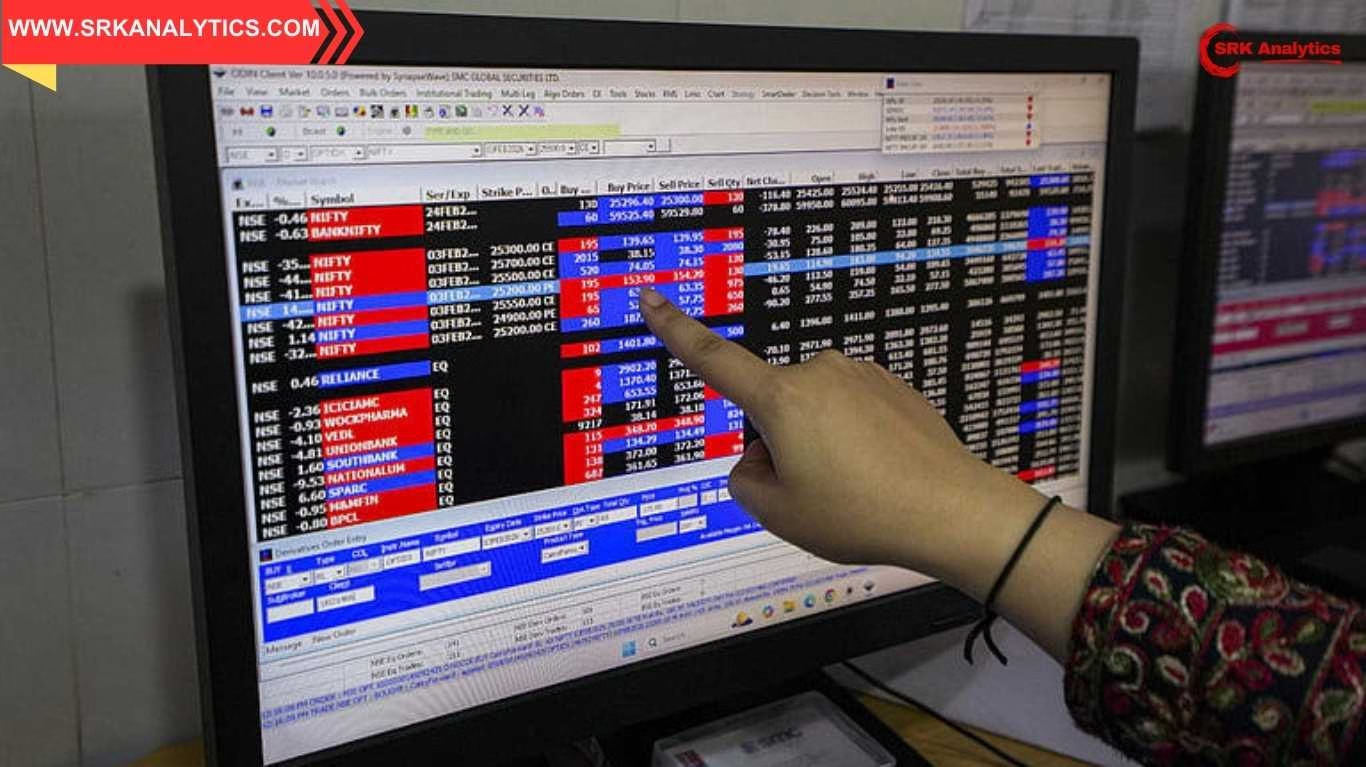
The Indian equity markets witnessed a session of high-octane drama on February 4, 2026, as benchmark indices managed to scrape through with marginal gains. In a classic “tug-of-war” scenario, the BSE Sensex and NSE Nifty 50 faced a massive onslaught from the information technology (IT) sector but were rescued by a robust recovery in banking and financial heavyweights. The Sensex finished the day at 83,817.69, up by 78.56 points or 0.09%, while the Nifty 50 settled at 25,776.00, gaining 48.45 points or 0.19%.
The primary narrative of the day was the divergence between sectors. While the Nifty IT index plummeted nearly 6% in its worst single-day performance in nearly a year, the Nifty Bank index provided the necessary cushion, closing well above the 60,200 mark. This resilience came on the heels of the recently finalized India-U.S. trade deal, which has bolstered long-term sentiment despite immediate global headwinds in the technology space.
The IT Bloodbath: AI Fears and Global Cues
The defining feature of the day’s trade was the sharp “sell everything” mode in IT stocks. The trigger was not domestic but rather a global shift in sentiment regarding Artificial Intelligence (AI). Following the launch of advanced productivity tools by U.S.-based AI firm Anthropic, global investors began reassessing the traditional IT outsourcing model.
The fear that AI “agents” could soon replace human-led software services led to a massive rout on Wall Street overnight, which spilled over into the Indian markets. Heavyweights like Infosys, TCS, and Wipro bore the brunt of the selling pressure, with some counters losing as much as 8% of their value in a single session.
Banking Sector to the Rescue
While the IT sector was bleeding, the banking and financial services sector emerged as the white knight. ICICI Bank, Axis Bank, and State Bank of India (SBI) saw significant buying interest. This was partly driven by the commencement of the RBI’s Monetary Policy Committee (MPC) meeting. Investors are optimistic that the central bank, led by Governor Sanjay Malhotra, will maintain a growth-supportive stance, especially following the fiscally disciplined Union Budget 2026.
The banking sector’s strength was also supported by the cooling of bond yields and steady foreign institutional investor (FII) inflows, which turned positive after the landmark trade agreement with the United States.
Snapshot of Market Performance (February 4, 2026)
The following data illustrates the closing positions of the primary indices and the stark contrast between the winning and losing sectors.
| Index | Closing Value | Change (Points) | Change (%) |
| BSE Sensex | 83,817.69 | +78.56 | 0.09% |
| NSE Nifty 50 | 25,776.00 | +48.45 | 0.19% |
| Nifty Bank | 60,238.15 | +122.05 | 0.20% |
| Nifty IT | 35,311.34 | -2,253.60 | -6.00% |
| Nifty Midcap 100 | 62,450.00 | +393.45 | 0.63% |
| Nifty Smallcap 100 | 19,820.50 | +248.60 | 1.27% |
Top Gainers and Losers: Nifty 50 Breakdown
Despite the flat finish of the benchmarks, individual stock movements were quite volatile. The “broader market” actually outperformed the frontline indices, with small and mid-cap stocks showing significant strength.
| Top Gainers | Price (Rs) | Change (%) | Top Losers | Price (Rs) | Change (%) |
| Adani Ports | 1,482.00 | +2.25% | Infosys | 1,522.00 | -8.00% |
| Reliance Ind. | 3,145.50 | +1.27% | Persistent Sys. | 5,824.00 | -7.30% |
| ICICI Bank | 1,310.20 | +1.18% | TCS | 3,016.00 | -6.50% |
| Power Grid | 345.00 | +1.10% | Wipro | 232.00 | -6.20% |
| M&M | 2,890.00 | +1.05% | HCL Tech | 1,480.00 | -6.15% |
Analysis of the India-U.S. Trade Deal Impact
One of the reasons the Indian markets didn’t collapse under the weight of the IT selloff was the residual optimism from the India-U.S. trade deal finalized earlier this week. The deal, which effectively lowers tariffs on Indian exports to the U.S. from 50% to 18%, is seen as a generational shift for Indian manufacturing and logistics.
- Logistics & Ports: Shares of Adani Ports and Shipping Corp of India have been primary beneficiaries of this news, as trade volumes are expected to surge.
- Auto & Metal: Export-oriented auto firms like Mahindra & Mahindra and metal giants like Tata Steel found favor as the trade barriers began to dissolve.
- The Trade-off: India’s commitment to move away from Russian oil and invest $500 billion into U.S. energy and tech sectors has stabilized the rupee, providing a tailwind for the broader financial ecosystem.
Broader Market Sentiment and Mid-caps
Interestingly, while the “big boys” in the IT space were struggling, the broader market remained remarkably resilient. The Nifty Smallcap 100 jumped 1.27%, indicating that retail and domestic institutional investors (DIIs) are finding value in niche segments.
Consumer durables and energy were the standout sectors. The Nifty Consumer Durables index rose 2.6%, fueled by expectations of strong rural demand following Budget 2026’s focus on agricultural productivity. Companies like Trent and NTPC also reached new milestones during the session.
Technical Outlook: What Lies Ahead for Nifty?
Technically, the Nifty 50 formed a “bullish candle” with a long lower shadow on the daily charts. This suggests that while there was a sharp dip in the morning—touching a low of 25,563—there was aggressive “buying on dips” at lower levels.
- Support Levels: Analysts now place immediate support at the 25,600–25,650 zone. As long as the index holds this level, the medium-term bullish structure remains intact.
- Resistance Levels: On the upside, 25,850 remains a stiff hurdle. A sustained close above this could open the doors for the Nifty to test the psychological 26,000 mark.
- VIX Watch: The India VIX (Volatility Index) dropped by nearly 5% to settle at 12.25, indicating that despite the IT rout, there is no widespread panic among investors.
Sector-Wise Capital Flows
The divergence in performance is also reflected in the sector-wise weightage and capital movements observed during the day.
| Sectoral Index | Closing Value | Day’s Change (%) | Sentiment |
| Nifty Auto | 26,100.50 | +1.45% | Bullish |
| Nifty Energy | 38,920.00 | +2.10% | Very Bullish |
| Nifty Pharma | 21,450.75 | -0.34% | Neutral |
| Nifty Realty | 980.20 | -0.80% | Cautious |
| Nifty Oil & Gas | 12,850.00 | +2.05% | Bullish |
Macroeconomic Factors: RBI MPC and Services PMI
The market also processed two critical pieces of economic data on Wednesday:
- HSBC India Services PMI: The services sector activity expanded to a two-month high of 58.5 in January, up from 58.0 in December. This data point reinforced the “India growth story,” helping investors overlook the global tech volatility.
- RBI MPC Meeting: The three-day monetary policy meeting commenced today. With inflation hovering near the lower end of the target band, there are whispers of a potential “dovish” commentary, if not a rate cut, which kept the banking stocks buoyant.
Global Market Context
The Indian markets are currently in a unique position where they are decoupled from the “AI-panic” seen in Japan’s Nikkei or the U.S. Nasdaq. While Indian IT firms provide services to the global software giants, the domestic Indian economy is currently driven by massive infrastructure spending and internal consumption. This “dual-speed” economy was on full display today—where the global-facing sector (IT) crashed, but the domestic-facing sectors (Banks, Auto, Energy) flourished.
Conclusion
The session on February 4, 2026, will be remembered as a day of “structural rebalancing.” The era of “easy growth” for traditional IT services is being challenged by generative AI, leading to a significant valuation correction. However, the Indian markets have shown they are no longer a one-trick pony. The strength of the banking sector, combined with the tailwinds of the India-U.S. trade deal, has provided a sturdy foundation.
Investors are now looking forward to the RBI’s policy announcement on Friday, which will likely set the tone for the remainder of the month. For now, the “buy on dips” strategy seems to be prevailing, as benchmarks close slightly higher despite the massive IT selloff.
Disclaimer: This news report is for informational purposes only and does not constitute financial or investment advice. Stock market investments are subject to market risks. Readers are encouraged to conduct their own research or consult with a certified financial advisor before making any trading or investment decisions based on the information provided herein.