




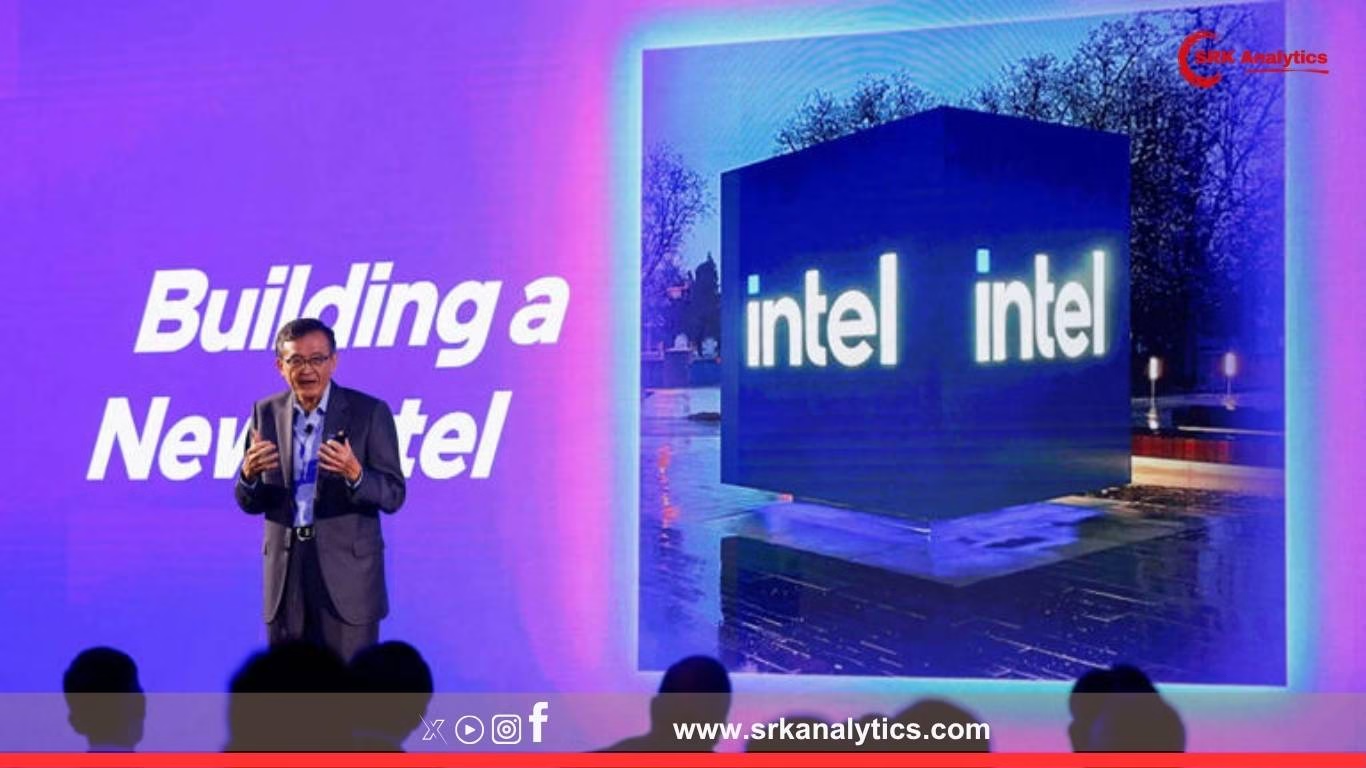
In a bold strategic shift signaling a new era for one of the world’s largest semiconductor companies, Intel Corporation has announced the separation of its networking unit as part of a broader overhaul led by its newly appointed Chief Executive Officer, Frank Tan. The move comes amid intensifying global competition in chipmaking and growing investor pressure to streamline operations for greater efficiency and profitability.
Tan, who officially assumed the top role earlier this year, is spearheading a multi-phase restructuring plan designed to reposition Intel as a more agile, innovation-led company focused on its core chipmaking business, while exploring opportunities in high-growth adjacent segments like AI, data centers, and edge computing.
The spin-off of Intel’s Network and Edge Group (NEX) into an independent entity is seen as a major step in Tan’s turnaround blueprint, potentially unlocking value through operational focus and strategic partnerships. The reorganization reflects a broader industry trend, where technology giants are opting to break up sprawling divisions in favor of nimble, market-driven units.
Why Intel is Spinning Off Its Networking Business
The decision to carve out the networking division stems from both financial and strategic imperatives. Over the past few quarters, Intel’s networking business — though growing modestly — has faced stiff competition from rivals like NVIDIA, Broadcom, and AMD, especially in segments like smartNICs, Ethernet solutions, and 5G infrastructure components.
Key reasons behind the move include:
- Refocused business vision under Frank Tan
- Need to sharpen core semiconductor strategy
- Capitalizing on strong AI and data center momentum
- Better capital allocation and ROI visibility
- Unlocking shareholder value via potential IPO or external investment
By separating the NEX unit, Intel aims to empower it with greater operational autonomy, faster decision-making, and the ability to innovate independently — while still benefiting from Intel’s ecosystem and fabrication capabilities.
Overview of Intel’s Restructuring Under Frank Tan
| Division | Status | Planned Action | Timeline |
|---|---|---|---|
| Client Computing Group (CCG) | Core Unit | Retain and expand AI integration | Ongoing |
| Data Center & AI Group (DCAI) | High Growth Focus | Increased R&D, market expansion | FY2025-FY2026 |
| Foundry Services | Strategic Priority | External customer onboarding, expansion | H2 2025 |
| Network and Edge Group (NEX) | Spun-Off as Separate Entity | Legal, structural separation underway | By mid-2026 |
| Mobileye (Autonomous driving) | Semi-independent | May consider IPO expansion | Evaluating |
| Programmable Solutions (PSG) | Strategic Realignment | Focus on cloud-custom silicon | FY2025 |
A Closer Look at the Network and Edge Group (NEX)
Intel’s NEX division was originally formed by merging the company’s network infrastructure and edge computing operations. It focused on next-gen connectivity solutions, including 5G platforms, network processors, edge servers, and industrial IoT.
In 2023, NEX generated approximately $7.6 billion in revenue, accounting for nearly 9% of Intel’s total revenue. Despite being a profitable unit, its margin contribution was reportedly lower than the core client and data center businesses.
Now, as a separate entity, NEX will have its own leadership structure, budget, and growth strategy. It may pursue external funding, joint ventures, or even a partial public listing to drive innovation and market share.
Strategic Advantages of the NEX Spin-Off
- Operational Efficiency: Leaner organization with focused leadership and faster execution cycles.
- Innovation Agility: NEX can independently pursue niche markets and develop customized solutions.
- Financial Clarity: Intel can reduce complexity in financial reporting, enhancing shareholder transparency.
- Potential Valuation Unlock: NEX could attract tech-focused investors and unlock value not reflected in Intel’s current valuation.
- Better Talent Allocation: Dedicated teams can be hired and deployed based on business-specific needs.
Intel’s FY2024 Business Snapshot (Pre-Reorg)
| Business Segment | Revenue (USD Billion) | YoY Growth | Contribution to Total Revenue (%) |
|---|---|---|---|
| Client Computing Group (CCG) | 31.4 | +5% | 36.2% |
| Data Center & AI Group (DCAI) | 23.8 | +8% | 27.5% |
| Network and Edge Group (NEX) | 7.6 | +4% | 8.8% |
| Intel Foundry Services | 5.1 | +32% | 5.9% |
| Mobileye | 2.1 | +12% | 2.4% |
| Others | 17.0 | -2% | 19.2% |
What Analysts Are Saying
Market analysts have broadly welcomed the decision, calling it a “strategic pivot” necessary to rejuvenate Intel’s long-term prospects. Analysts expect the reorg to help Intel focus on its competitive strengths in process technology, advanced packaging, and AI computing.
Some believe the restructuring is a signal that Intel is serious about transitioning from an integrated device manufacturer (IDM) to a more modular, collaborative tech ecosystem player, similar to how Amazon spun off AWS or how Alphabet split up its moonshot projects.
CEO Frank Tan’s Vision: Rebuilding a Tech Titan
Since taking over, Frank Tan has outlined a bold roadmap to restore Intel’s lost edge in global semiconductor leadership. His key priorities include:
- Accelerating the Intel Foundry Services (IFS) initiative to rival TSMC and Samsung
- Expanding Intel’s AI portfolio across edge, client, and cloud
- Enhancing manufacturing capabilities in Europe and the U.S.
- Simplifying Intel’s sprawling structure to focus on execution and innovation
Tan’s leadership has already led to a 15% rise in Intel’s stock price since the beginning of the year, indicating investor confidence in the company’s new direction.
Competitive Landscape in Networking and Edge Computing
The global networking and edge computing market is rapidly evolving, and Intel’s competitors are already well-positioned. Here’s a snapshot of the competition NEX will face as a standalone business:
| Company | Core Focus Areas | Estimated Revenue in Segment (2024) |
|---|---|---|
| NVIDIA | AI-driven networking, DPUs | $10.5 billion |
| Broadcom | Ethernet solutions, switching tech | $9.1 billion |
| AMD | Embedded edge, EPYC networking chips | $3.6 billion |
| Marvell Tech | 5G infrastructure, custom ASICs | $2.9 billion |
| Qualcomm | Edge AI, 5G platforms | $6.8 billion |
NEX will need to rely on strategic differentiation, ecosystem partnerships, and cutting-edge R&D to maintain and grow its market position.
Potential Outcomes of the NEX Separation
- IPO or strategic investment within 12–18 months
- Potential partnerships with telcos, hyperscalers, or industrial IoT players
- New leadership appointments with a tech innovation background
- Rebranding of the new entity with independent marketing and growth strategy
Conclusion
Intel’s move to spin off its networking unit as part of Frank Tan’s transformational overhaul marks a pivotal moment in the company’s storied history. As the semiconductor landscape grows more complex and competitive, Intel’s strategy of sharpening its focus on core competencies while fostering autonomy in non-core segments could prove to be a winning formula.
With the right leadership, capital backing, and product innovation, both Intel and the new NEX entity stand to gain — redefining the future of computing, connectivity, and chip-level integration.
Disclaimer:
This article is intended for informational purposes only and does not constitute investment, financial, or business advice. Company plans, market projections, and organizational strategies mentioned are based on public announcements and industry analysis and may change in the future.