




India’s private sector economy continued its upward trajectory in July, fueled by a resurgent manufacturing sector that posted its strongest performance in over 17 years. According to the latest survey data, the Manufacturing Purchasing Managers’ Index (PMI) rose sharply, signaling the sector’s robust expansion amid sustained domestic demand, growing output, and new business inflows.
The Manufacturing PMI reached a remarkable 58.8 in July 2025, the highest reading since October 2007, marking an important milestone in India’s post-pandemic economic recovery. This momentum was accompanied by a solid services sector expansion, keeping the composite PMI firmly in the growth territory.
Manufacturing PMI Surges to Multi-Year High
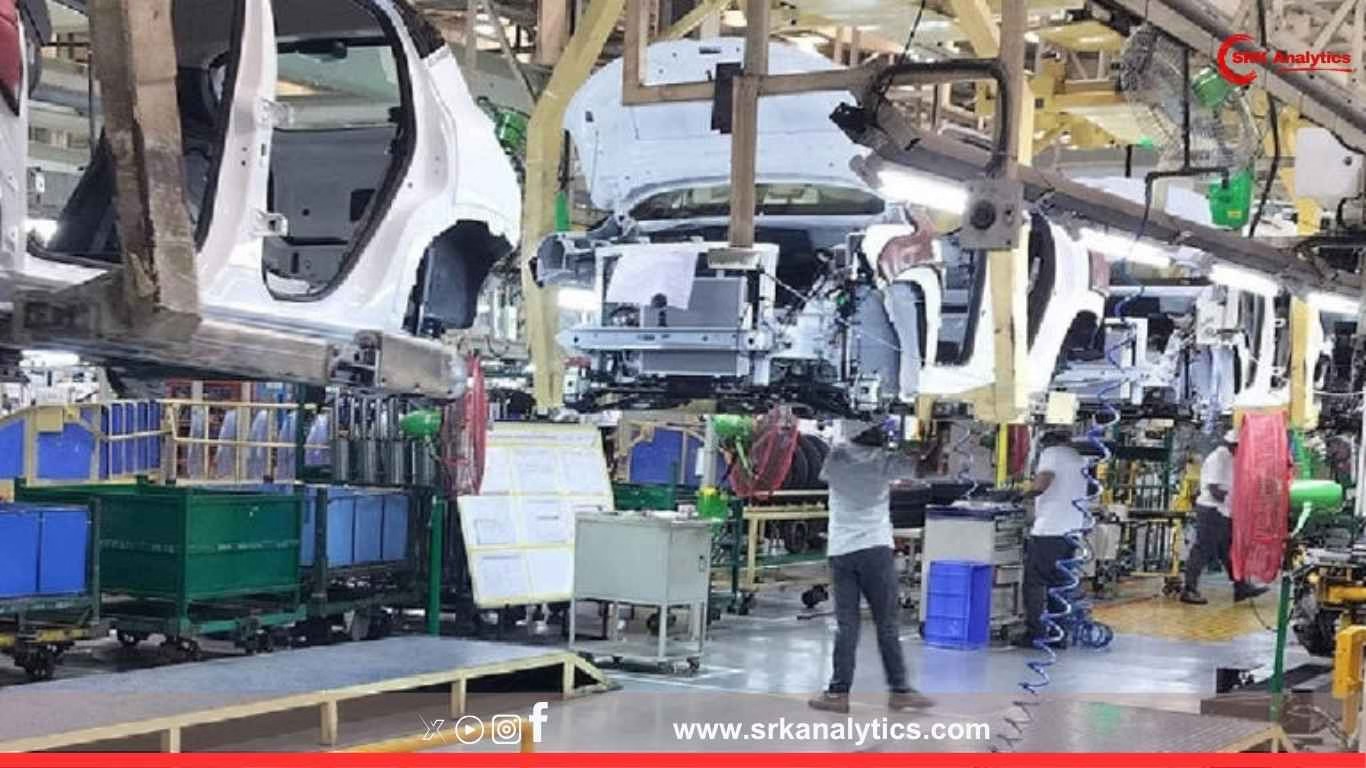
India’s factory activity saw accelerated growth in July due to a combination of strong domestic orders, favorable input conditions, and improved business confidence. The July PMI data points to faster increases in output, new orders, and employment, all contributing to the sector’s highest performance in nearly two decades.
Key highlights from the July 2025 Manufacturing PMI:
| Indicator | July 2025 | June 2025 | Trend |
|---|---|---|---|
| Manufacturing PMI | 58.8 | 57.5 | Highest since 2007 |
| Output Index | 59.6 | 58.0 | Strong increase |
| New Orders | 60.1 | 58.3 | Accelerated demand |
| Employment Index | 52.7 | 51.9 | Moderate hiring |
| Input Price Inflation | 54.3 | 53.5 | Mild uptick |
| Business Confidence Index | 63.2 | 60.4 | Strong optimism |
These figures signal continued improvement in factory operations, with optimism running high among Indian manufacturers. Firms attributed the boost to government infrastructure spending, festive season preparation, and new product pipelines.
Services Sector Maintains Solid Pace
India’s services economy also held strong in July, with firms reporting steady growth in new business, hiring, and demand across hospitality, IT, logistics, and financial services. Although not as explosive as manufacturing, the services PMI remained comfortably above the neutral 50 mark, reinforcing the private sector’s balanced performance.
| Indicator | July 2025 | June 2025 | Comment |
|---|---|---|---|
| Services PMI | 57.2 | 56.8 | Resilient growth across categories |
| Composite PMI (Mfg + Svc) | 58.1 | 57.1 | Unified sector expansion |
India’s composite PMI, which combines both manufacturing and services output, shows a continued upward trend for the seventh consecutive month, indicating broad-based economic expansion.
Domestic Demand Driving Private Sector Resilience
The robust PMI figures reflect India’s resilient domestic economy, even as global headwinds persist. Several factors are fueling this strong private sector momentum:
- Rising consumer demand in both urban and semi-urban areas.
- Private investment recovery supported by government incentives under PLI schemes.
- Healthy corporate earnings enabling capacity expansion and hiring.
- Strong festival season buildup, particularly in retail, FMCG, and e-commerce.
- Supply chain normalization, which is reducing delivery backlogs.
As a result, Indian firms, particularly small and medium enterprises (SMEs), are showing greater optimism toward expansion, capex, and exports, especially in electronics, textiles, and chemicals.
Employment and Wages on the Rise
While employment growth has remained moderate compared to output growth, July witnessed the fastest pace of hiring in over 18 months. With increased demand, companies are ramping up manpower in both technical and support roles.
Wages also saw incremental increases, with firms citing greater competition for skilled labor. Sectors like manufacturing, logistics, IT services, and hospitality led the charge in workforce additions.
| Sector | Hiring Trend (July 2025) | Wage Growth Comment |
|---|---|---|
| Manufacturing | Upward | Steady hike, especially skilled labor |
| Services | Stable to Upward | Selective hikes in IT and hospitality |
| Logistics & Supply Chain | Strong hiring | Surge in demand for last-mile delivery |
| Retail & E-commerce | Seasonal hiring | Pre-festive temporary workforce surge |
Inflation Pressures Mild But Watchful
Though input costs edged slightly higher in July, led by increases in transport, commodity-linked materials, and select imports, firms largely held output prices steady to remain competitive. However, the pass-through of some input cost pressure is expected in August if raw material inflation persists.
Manufacturers, particularly in automotive, FMCG, and textiles, are closely watching global commodity prices, oil movements, and the currency impact on imports to manage costs effectively.
Outlook: Economic Expansion Poised to Continue
India’s economic outlook remains positive, with key high-frequency indicators — such as GST collections, power demand, vehicle sales, and credit growth — supporting the PMI data. With the central government expected to maintain its capital expenditure spree and the monsoon remaining normal across key regions, both consumption and investment demand are likely to stay buoyant in Q2 and Q3 FY26.
Ventures in renewables, defense manufacturing, semiconductor fabs, and green hydrogen are expected to provide additional tailwinds to the industrial economy.
Analyst Views
Economists and analysts see the July PMI print as a critical marker of India’s sustained growth amid a challenging global environment. Many agree that India continues to outperform most large economies, with its unique combination of domestic demand and policy-driven supply-side reforms.
Some concerns were raised about potential export softness due to global slowdown, but strong local demand and Make in India policies are expected to absorb these shocks in the medium term.
Sector-Wise PMI Expansion Snapshot – July 2025
| Sector | PMI Indication | Comment |
|---|---|---|
| Automotive | Expanding Fast | Driven by domestic orders and EV parts exports |
| Capital Goods | Strong Momentum | Government infra push and defense orders |
| Consumer Goods (FMCG) | Stable Growth | Demand recovery in Tier 2 and rural regions |
| Textiles & Apparel | Moderate Growth | Domestic uptrend but export weakness |
| Pharmaceuticals | Slight Expansion | Domestic focus, export volatility remains |
| Information Technology | Gradual Uptick | Resumption of offshore projects and cloud demand |
Conclusion
The July PMI report provides a clear signal of India’s economic resilience, especially in manufacturing, which hit a 17-year high. With supportive macro fundamentals, strong policy push, and robust demand from both urban and rural markets, India’s private sector is poised to lead the economy through the second half of FY26.
The consistent expansion in manufacturing and services sectors paints an encouraging picture for job creation, industrial output, and sustained GDP growth in the coming quarters.
Disclaimer: The above content is for informational and analytical purposes only. It does not constitute investment, economic, or policy advice. Readers are advised to interpret economic data in context and consult with professional advisors before making financial or business decisions.