
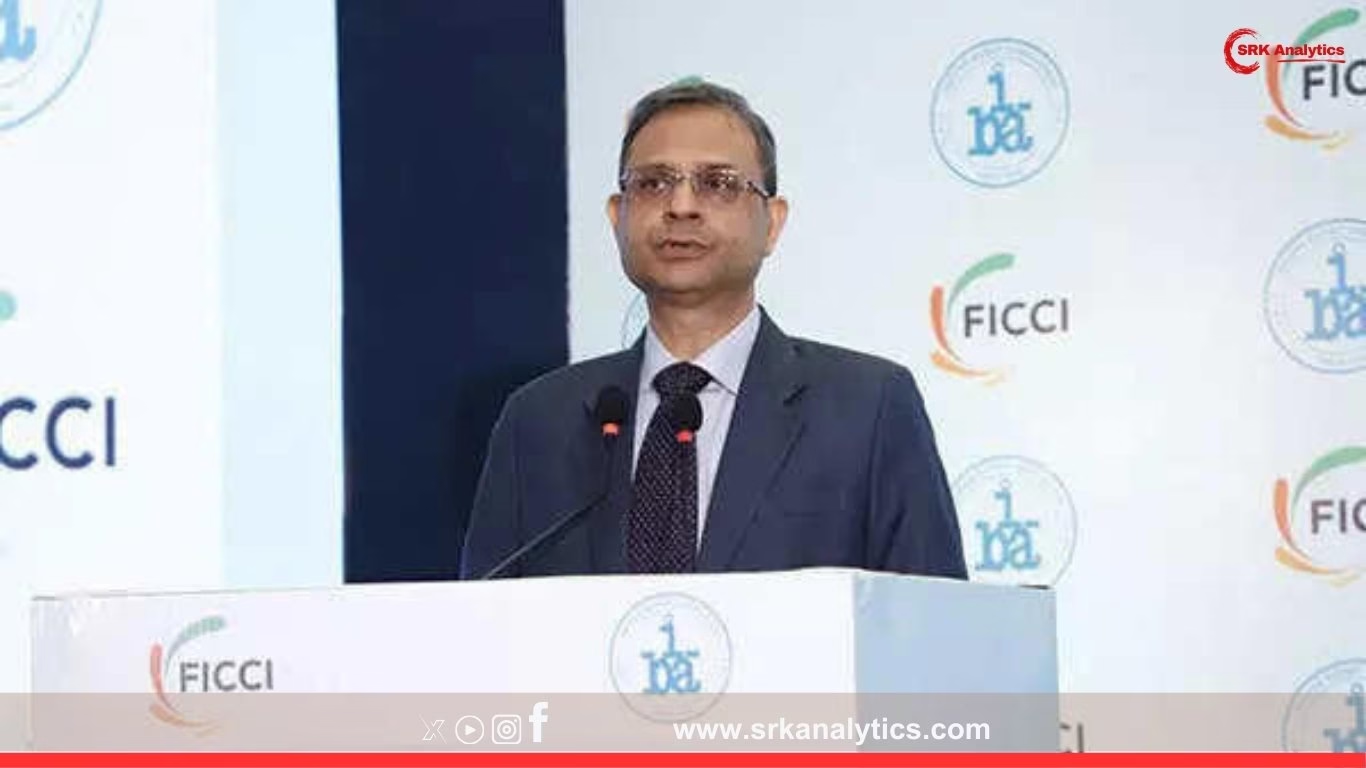
India is on the cusp of becoming the world’s third-largest economy, according to Reserve Bank of India (RBI) Governor Sanjay Malhotra. Speaking at the ‘Santripti Shivir’ financial inclusion campaign in Rangwasa village, Indore, Malhotra hailed the Pradhan Mantri Jan Dhan Yojana (PMJDY) as a transformative force that has laid the foundation for inclusive growth and economic resilience.
His remarks come on the heels of India’s impressive 7.8% GDP growth in the April–June quarter of FY2025–26, the highest in five quarters, even as global headwinds—including heavy tariffs from the United States—pose challenges to emerging economies.
🧭 Key Highlights from RBI Governor’s Address
| Theme | Statement Summary | Strategic Implication |
|---|---|---|
| Economic Growth | “India will soon be the world’s third-largest economy” | Signals confidence in macro fundamentals |
| Jan Dhan Yojana Impact | “55 crore accounts opened in 11 years” | Financial inclusion across all demographics |
| Women’s Participation | “Women are playing a major role in development” | Gender-inclusive growth |
| Digital Banking Push | “Use UPI and digital platforms to avoid fraud” | Promotes fintech adoption |
| KYC Compliance | “Update Jan Dhan accounts to prevent misuse” | Strengthens banking security |
Malhotra emphasized that India is already counted among the five most developed countries and is poised to climb further due to its robust financial infrastructure and inclusive policy frameworks.
📊 Jan Dhan Yojana: 11-Year Impact Snapshot
| Metric | Value (as of August 2025) | Commentary |
|---|---|---|
| Total Accounts Opened | 55 crore | Covers urban and rural populations |
| Women Account Holders | 27 crore+ | Over 49% of total accounts |
| RuPay Cards Issued | 35 crore | Boosts digital payments |
| Direct Benefit Transfers (DBT) | ₹2.5 lakh crore+ | Subsidies, pensions, and welfare schemes |
| Average Balance per Account | ₹1,800 | Indicates growing savings culture |
Launched in August 2014, PMJDY aimed to provide universal access to banking services, especially for the unbanked and underbanked sections of society. Today, it stands as one of the world’s largest financial inclusion programs.
🔍 Financial Inclusion and Economic Growth Linkage
Malhotra credited PMJDY for enabling citizens to participate in the country’s economic journey through access to savings, credit, insurance, and pension schemes.
| Inclusion Driver | Economic Benefit | Long-Term Impact |
|---|---|---|
| Bank Account Access | Encourages savings and formal transactions | Reduces informal economy |
| DBT Mechanism | Efficient subsidy delivery | Cuts leakages and improves targeting |
| Microcredit Availability | Boosts entrepreneurship | Supports MSME sector |
| Insurance & Pension Schemes | Social security for vulnerable groups | Reduces poverty and financial stress |
| Digital Literacy Campaigns | Promotes secure digital transactions | Builds trust in fintech |
The RBI Governor also urged account holders to complete their Know Your Customer (KYC) updates to prevent misuse and ensure compliance.
📉 Mule Accounts and KYC Compliance
Malhotra warned about the risk of ‘mule accounts’—bank accounts used for laundering illicit funds, often without the knowledge of the account holder. He stressed the importance of KYC updates to safeguard the integrity of the financial system.
| Risk Factor | Description | Mitigation Strategy |
|---|---|---|
| Mule Accounts | Used for illegal fund transfers | Mandatory KYC updates |
| Digital Fraud | Phishing, OTP scams, identity theft | Financial literacy and awareness campaigns |
| Account Dormancy | Inactive accounts vulnerable to misuse | Periodic activity checks |
He also encouraged citizens to embrace digital banking platforms like UPI, which have already revolutionized India’s payment ecosystem.
🔥 India’s GDP Growth and Global Ranking Trajectory
India’s economy grew 7.8% in Q1 FY2025–26, driven by strong performance in services, manufacturing, and private consumption. The country is currently the fifth-largest economy, behind the US, China, Japan, and Germany.
| Country | GDP (Nominal, USD Trillion) | Global Rank (2025) | Projected Rank (2027) |
|---|---|---|---|
| United States | 26.7 | 1 | 1 |
| China | 19.4 | 2 | 2 |
| Japan | 4.4 | 3 | 4 |
| Germany | 4.2 | 4 | 5 |
| India | 3.9 | 5 | 3 |
India is expected to surpass Japan and Germany by 2027, driven by demographic advantage, digital infrastructure, and policy reforms.
🧠 Expert Opinions on India’s Economic Outlook
| Expert Name | Designation | Comment |
|---|---|---|
| Dr. Rakesh Sinha | Macroeconomist | “Jan Dhan Yojana has democratized finance.” |
| Prof. Meera Iyer | Development Economist | “Financial inclusion is key to sustainable growth.” |
| Rajiv Bansal | Banking Consultant | “Digital banking and UPI are game-changers.” |
Experts agree that India’s inclusive growth model, backed by schemes like PMJDY, is laying the groundwork for long-term economic leadership.
📌 Conclusion
RBI Governor Sanjay Malhotra’s assertion that India is on track to become the world’s third-largest economy reflects growing confidence in the country’s macroeconomic fundamentals and inclusive development strategy. By crediting the Pradhan Mantri Jan Dhan Yojana for its role in financial empowerment, Malhotra highlighted the transformative power of policy-driven inclusion.
With 55 crore accounts opened, rising digital adoption, and strong GDP growth, India’s economic ascent is not just a projection—it’s a reality in motion. As the country continues to invest in infrastructure, innovation, and human capital, the journey toward becoming a global economic powerhouse appears well within reach.
—
Disclaimer: This article is based on publicly available news reports and official statements as of August 31, 2025. It is intended for informational purposes only and does not constitute financial, economic, or policy advice.