
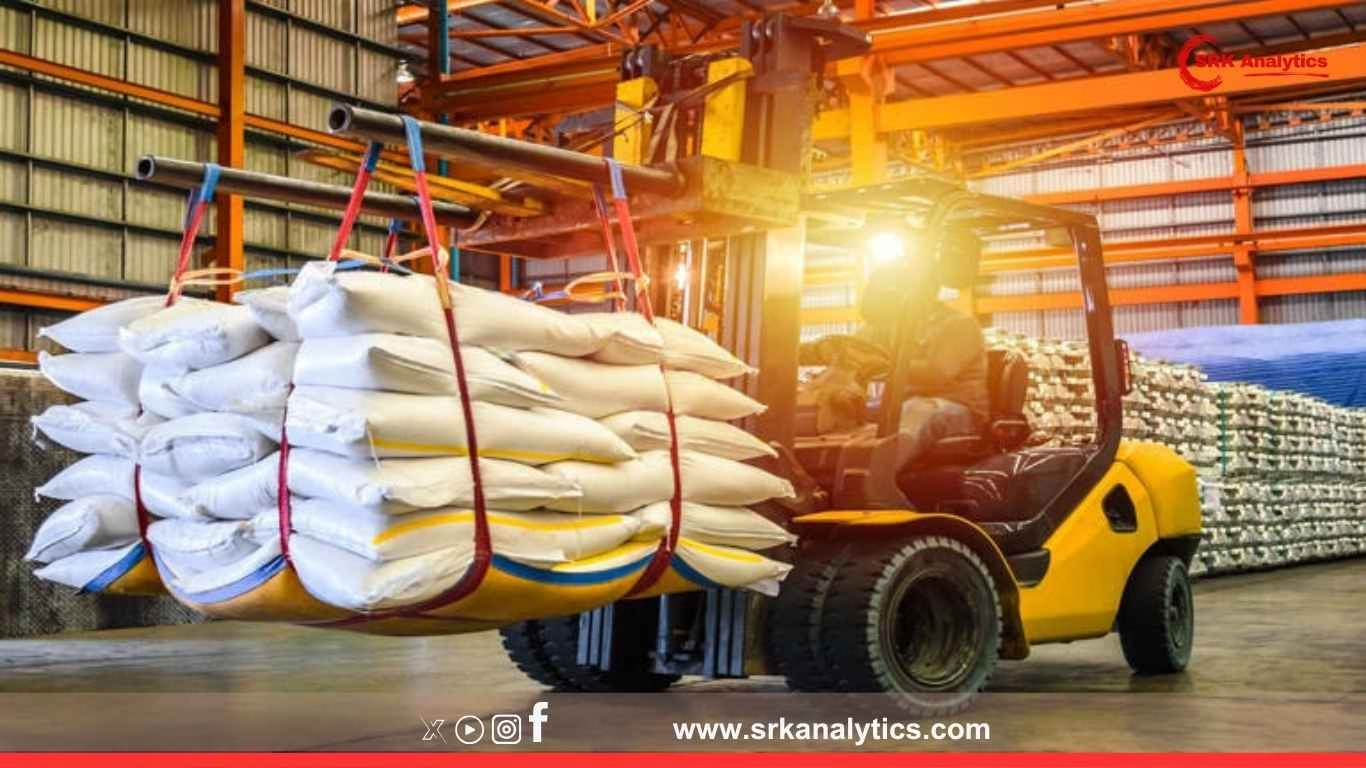
In a move seen as a strategic balancing act between domestic supply management and trade commitments, India has officially notified a sugar export quota of 5,841 tonnes to the European Union (EU) under the CXL concessions for the 2025-26 quota year. The announcement, made by the Directorate General of Foreign Trade (DGFT), allows selected exporters to fulfill tariff rate quota (TRQ) obligations with preferential customs duty under World Trade Organization (WTO) guidelines.
This development comes at a time when the Indian sugar sector has been facing tight supply conditions due to a decline in cane output, erratic monsoons in Maharashtra and Karnataka, and increased diversion of sugarcane for ethanol production. Yet, the government remains committed to maintaining its international trade agreements, especially with the EU, where it enjoys tariff concessions in return for strict quota discipline.
The notification also reassures global buyers about India’s continued presence in niche sugar markets, even as broader sugar exports from India remain under severe restrictions due to domestic price control and inventory planning.
Understanding the EU Quota: What is the CXL Concession?
The CXL quota is part of India’s WTO commitments, especially toward the European Union’s reallocation of trade preferences post-enlargement. Under this scheme, India is allowed to export a specific amount of sugar to the EU at lower or zero tariff rates annually. The 5,841 tonnes quota, though small compared to India’s typical export capacity, is a crucial part of bilateral trade diplomacy and strategic export engagement.
This quota is separate from India’s broader sugar export policy, which remains restrictive for the general market due to fears of inflation and insufficient domestic buffer stock.
Quota Distribution Among Exporters
As per DGFT’s notification, sugar exports under this quota will be subject to prior registration and will be closely monitored through Electronic Data Interchange (EDI) and pre-shipment approvals.
| Exporter Category | Allotment Share (%) | Estimated Quota (Tonnes) |
|---|---|---|
| State Trading Enterprises (STEs) | 50% | 2,920.5 |
| Private Exporters (with EU history) | 30% | 1,752.3 |
| New Entrants (SMEs/EOUs) | 20% | 1,168.2 |
| Total | 100% | 5,841 |
Exporters will be required to submit proof of destination, certificates of origin, and must comply with EU traceability and quality norms, which include low sulphur content, granulation specifications, and non-GMO certification.
India’s Broader Sugar Export Scenario
While the EU quota is a niche opportunity, India has otherwise curtailed its bulk sugar exports for the past two years. With an expected fall in sugar production to 31.5 million tonnes in the 2024-25 season (from 33.1 million tonnes in 2023-24), the government has kept a tight grip on exports to ensure that domestic availability, inflation control, and ethanol blending targets are prioritized.
| Year | Sugar Production (MT) | Export Volume (MT) | Domestic Consumption (MT) | Sugar diverted to Ethanol (MT) |
|---|---|---|---|---|
| 2022-23 | 35.9 | 11.2 | 27.5 | 4.5 |
| 2023-24 | 33.1 | 6.0 | 27.8 | 4.2 |
| 2024-25 (E) | 31.5 | <1.0 (CXL only) | 28.1 | 4.6 |
As evident, the focus has shifted to ethanol and ensuring domestic supplies, with exports reserved only for TRQ commitments like the CXL quota to EU and the U.S. sugar quota under the Generalized System of Preferences (GSP).
Why EU Market Still Matters
Despite its small size, the EU sugar market offers Indian exporters premium pricing, quality recognition, and long-term brand visibility. Industry insiders view the CXL quota as a foot-in-the-door opportunity for Indian refined sugar to enter high-value European markets.
Premiums of €80–€120 per tonne over world market prices are often fetched for high-quality Indian refined sugar exported to the EU. This price advantage, even for small quantities, helps:
- Build stronger bilateral trade narratives.
- Keep Indian brands relevant in international food and beverage supply chains.
- Open opportunities for value-added segments like organic sugar, jaggery powders, and specialty sugars.
Exporters React Positively
Ramesh Pawar, Managing Director of Pawar Sugar Exports Pvt. Ltd., a regular exporter under the EU quota, said:
“Even 5,000 tonnes is important to us because we get exposure to the most quality-conscious market in the world. It also lets us hedge part of our refining capacity through premium pricing.”
Nisha Desai, Director at Gujarat Organic Sugar Co., added:
“We see the EU market not just as an outlet but as a gateway for other high-value regions. Their importers demand traceability, quality, and certifications, which raise our overall process standards.”
Challenges to Watch
While the move is strategically beneficial, exporters and analysts warn of several hurdles:
- Strict EU compliance requirements: Traceability, certification, pesticide residue levels, and packaging standards must be met with zero tolerance.
- Logistics issues: The 5,841 tonnes require containerized shipments with temperature control—logistically more expensive than bulk sugar export.
- Rupee-Euro volatility: The premium margins can be eroded by unfavorable forex movement if contracts are not properly hedged.
Policy Balancing Act: Domestic vs Export
With inflationary pressures still haunting urban and rural markets, the government’s decision to limit sugar exports only to quota commitments reflects its cautious stance. Retail sugar prices have hovered at ₹44–₹48 per kg in major metros, and any further tightening in supply could tip prices beyond ₹50/kg, a politically sensitive threshold.
Meanwhile, India’s E20 ethanol blending programme (targeting 20% by 2026) continues to absorb significant sugarcane juice and B-heavy molasses, reducing the availability of sugar for both domestic and international use.
Future Outlook: Trade Strategy and Market Diversification
India’s sugar export strategy for the next three years is expected to rely on:
- Niche market focus (EU, U.S., Japan).
- Value-added sugar segments like organic, low GI, and fortified sugars.
- Strategic bilateral agreements for preferential tariffs.
- Flexible quotas tied to production forecasts and ethanol needs.
Government agencies may also look to digitize the TRQ application and monitoring process through blockchain-based EDI to enhance transparency and compliance.
Conclusion
India’s notification of a 5,841-tonne sugar export quota to the EU under the CXL agreement is a symbolic yet significant step in sustaining its global trade relevance, even as it grapples with tightening domestic supplies and high ethanol diversion. While the volume is modest, the economic, diplomatic, and branding value of this quota remains high, and it serves as an important indicator of India’s strategy to balance internal priorities with global trade obligations.
As exporters prepare to meet stringent EU norms, this move may also spur innovation and quality improvement across India’s sugar refining and packaging ecosystem. Going forward, such strategic export interventions could help Indian agribusinesses pivot toward higher-margin, compliance-oriented global markets.
Disclaimer: This article is intended for informational purposes only. It does not constitute trade advice, investment guidance, or endorsement of any organization. Readers should verify policies and consult relevant authorities or trade experts before making business or financial decisions.