




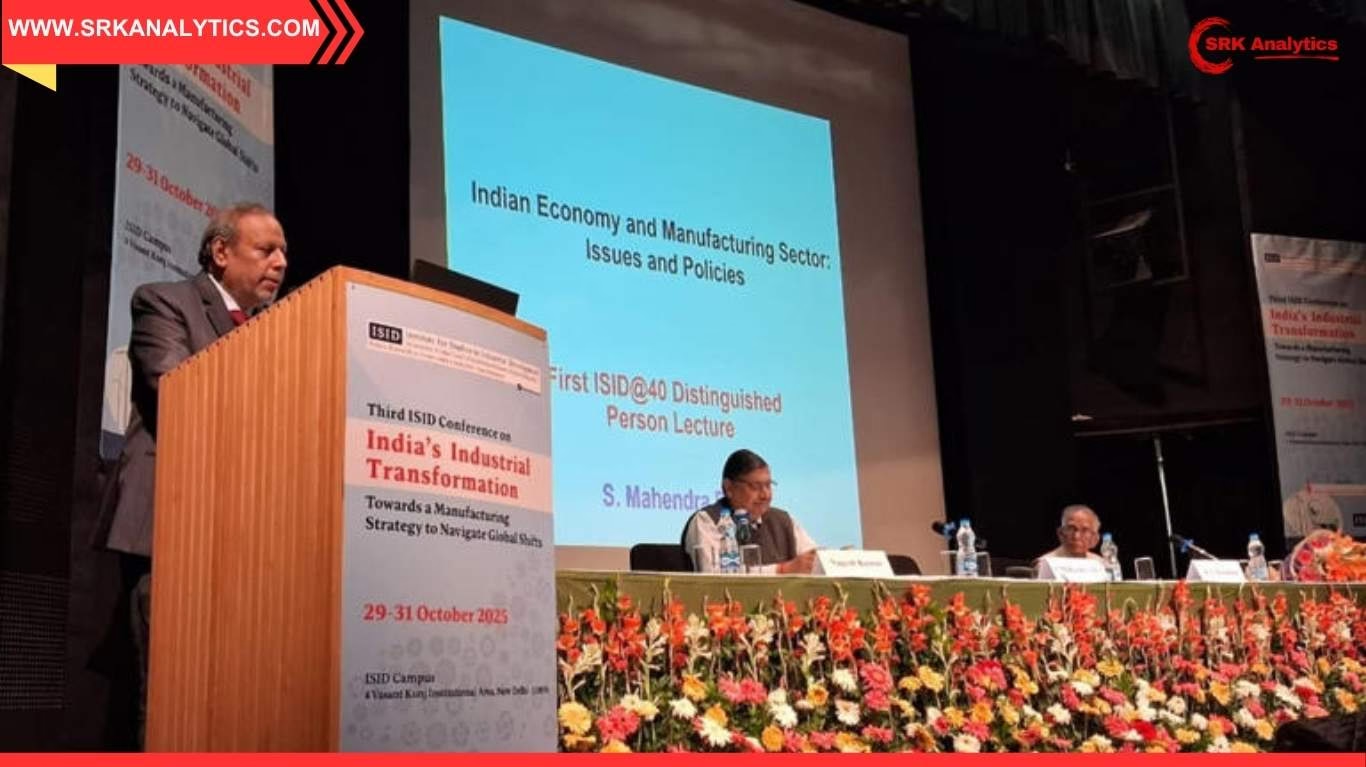
India’s long-term economic growth hinges on a decisive increase in its investment rate, according to S Mahendra Dev, Chairperson of the Economic Advisory Council to the Prime Minister (EAC-PM). Speaking at the First ISID@40 Distinguished Person Lecture in New Delhi, Dev emphasized that India must raise its investment rate from the current 31–32% to at least 34–35% of GDP to consistently achieve 7% annual growth. His remarks come amid growing concerns over sluggish private sector capital expenditure and the need for structural reforms to unlock India’s full economic potential.
Dev highlighted that while macroeconomic fundamentals remain strong, the private sector must play a more proactive role in driving capital formation. “Many firms are now debt-free and rich with cash. India Inc has to make new investments instead of keeping the cash,” he said, adding that uncertainty has long been cited as a reason for delayed investments, but the time has come to move beyond hesitation.
📊 India’s Investment Rate and Growth Correlation
| Indicator | Current Level (FY2025) | Target Level for 7% Growth |
|---|---|---|
| Investment Rate (% of GDP) | 31–32% | 34–35% |
| GDP Growth Rate | 6.5–6.9% | 7%+ |
| Private Sector Capex Share | ~25% | ≥30% |
| Public Sector Capex Share | ~7% | Maintain or increase |
The investment-to-growth ratio is a critical metric for sustaining long-term economic expansion.
🧠 Key Drivers for Raising Investment Rate
| Driver | Role in Boosting Investment |
|---|---|
| Rural and Urban Demand | Higher consumption spurs private investment |
| Export Push | Expanding global markets for Indian goods |
| Infrastructure Development | Roads, railways, and logistics efficiency |
| Policy Stability | Predictable regulatory environment |
| Financial Sector Liquidity | Easier access to credit for businesses |
Dev noted that India’s twin balance sheet problem is no longer a constraint, and capital availability is not an issue.
🏢 Sector-Wise Investment Potential
| Sector | Investment Opportunity (2025–2030) | Strategic Importance |
|---|---|---|
| Manufacturing | ₹15 lakh crore | Job creation, exports |
| Renewable Energy | ₹10 lakh crore | Climate goals, energy security |
| Digital Infrastructure | ₹8 lakh crore | AI, 5G, data centers |
| Urban Development | ₹6 lakh crore | Smart cities, housing |
| Agriculture & Food | ₹5 lakh crore | Rural income, food security |
These sectors are expected to drive India’s next wave of capital formation.
📈 Historical Investment Trends in India
| Year | Investment Rate (% of GDP) | GDP Growth Rate (%) |
|---|---|---|
| 2005 | 35.5% | 9.3% |
| 2010 | 34.8% | 8.5% |
| 2015 | 30.2% | 7.5% |
| 2020 | 28.9% | 4.0% (pandemic hit) |
| 2025 | 31.5% | 6.7% (estimated) |
The data underscores the strong correlation between investment rate and GDP growth.
🗣️ Policy Recommendations from EAC-PM Chair
| Recommendation | Intended Outcome |
|---|---|
| Incentivize Private Capex | Tax breaks, faster approvals |
| Strengthen MSME Financing | Credit access, digital onboarding |
| Promote FDI in Strategic Sectors | Technology transfer, global integration |
| Enhance Public Investment | Multiplier effect on private sector |
| Improve Ease of Doing Business | Reduce compliance burden |
Dev urged policymakers to create an environment where private investment becomes a natural outcome of economic confidence.
📌 Conclusion
India’s ambition to sustain 7% GDP growth over the next decade will require a strategic shift in its investment dynamics. As emphasized by EAC-PM Chair S Mahendra Dev, raising the investment rate to 34–35% of GDP is not just desirable—it is essential. With macroeconomic stability, liquidity, and policy support in place, the onus now lies on India Inc to step up and catalyze the next phase of growth. The path forward demands bold decisions, targeted reforms, and a renewed commitment to long-term capital formation.
Disclaimer: This article is based on publicly available statements and economic data. It is intended for informational purposes only and does not constitute financial or policy advice.