




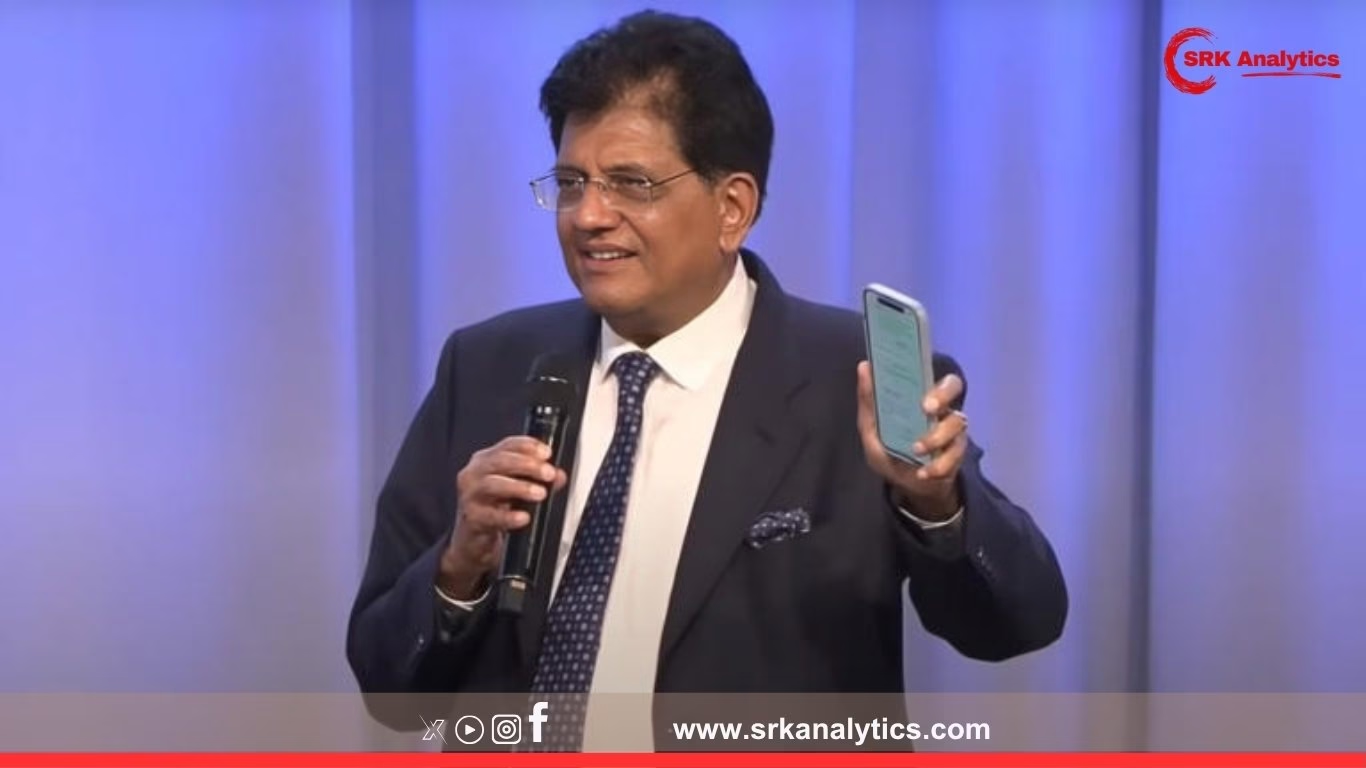
In a strong reaffirmation of India’s commitment to improving its investment climate, Union Minister of Commerce and Industry Piyush Goyal highlighted the country’s ability to swiftly resolve business challenges, further strengthening its image as a global business-friendly destination. Speaking at an industry interaction, Goyal emphasised that the government’s pro-active approach, policy reforms, and real-time problem resolution mechanisms have significantly boosted investor confidence, paving the way for accelerated growth in manufacturing, services, and technology sectors.
The minister underscored that India’s ease of doing business journey is not limited to procedural simplifications but extends to fostering a culture of accountability, efficiency, and innovation. According to him, the country’s quick problem-solving skills are now a defining feature of its economic governance.
India’s Business Transformation Journey
Over the past decade, India has made remarkable strides in improving its business environment. Several structural reforms—ranging from the introduction of the Goods and Services Tax (GST) to the digitisation of business clearances—have reduced red tape and enhanced operational efficiency.
One of the standout aspects of India’s reform agenda is the institutionalisation of industry grievance redressal systems, which ensure that issues are escalated and addressed in a timely manner. The Ministry of Commerce, through initiatives such as Invest India, has acted as a bridge between entrepreneurs and policymakers, creating an ecosystem where problem-solving is not just reactive but pre-emptive.
Global Recognition of India’s Efficiency
Goyal pointed out that multinational corporations and global investors have increasingly praised India’s responsiveness in resolving regulatory bottlenecks. The government’s use of technology-enabled platforms, digital single-window clearances, and a dedicated investment facilitation framework have set new benchmarks for efficiency.
This swift approach has played a vital role in attracting record levels of Foreign Direct Investment (FDI). According to official data, India attracted over USD 70 billion in FDI in the last financial year, with significant inflows into sectors such as manufacturing, renewable energy, pharmaceuticals, and digital services.
Comparative Ease of Doing Business Performance
While the World Bank has paused its official Ease of Doing Business rankings, independent analyses suggest that India remains a top performer among emerging economies in terms of business facilitation.
Ease of Doing Business Metrics – India vs. Key Asian Peers
| Indicator | India | Vietnam | Indonesia | Thailand | China |
|---|---|---|---|---|---|
| Average Time to Start a Business (days) | 18 | 21 | 25 | 27 | 30 |
| Average Cost to Start a Business (% of income per capita) | 7.2 | 8.1 | 9.4 | 7.5 | 9.2 |
| Digital Clearance Availability | High | Medium | Medium | Medium | High |
| Investor Protection Index (0-10) | 8.0 | 7.4 | 7.1 | 7.6 | 7.8 |
| Time to Resolve Commercial Dispute (days) | 1,445 | 1,500 | 1,650 | 1,580 | 1,400 |
This comparative analysis illustrates that India outperforms many of its Asian peers in cost-efficiency, speed of setting up businesses, and digital accessibility, though challenges remain in judicial efficiency.
Government’s Problem-Solving Model
Goyal attributed much of the progress to the government’s “3S Approach” — Speed, Simplicity, and Scalability.
- Speed: Rapid resolution of investor grievances through direct ministerial intervention and time-bound processes.
- Simplicity: Streamlining of procedures via single-window systems and reduction of compliance burden.
- Scalability: Ensuring that solutions can be applied across states and sectors, creating uniformity in business facilitation.
The minister highlighted recent cases where international companies facing import clearance delays received expedited approvals within days after raising the issue with relevant authorities—an example of how agile governance is attracting investment.
Impact on Domestic and Foreign Investors
The government’s responsiveness has benefited both domestic and foreign businesses. For Indian startups, especially in manufacturing and fintech, faster licensing and compliance clearance have enabled quicker product launches and market entry.
Foreign investors, meanwhile, have lauded the government’s readiness to resolve issues ranging from customs delays to policy ambiguities. This has directly contributed to India’s emergence as a preferred destination for global supply chain diversification in the post-pandemic world.
Sector-Wise Gains from Problem-Solving Reforms
| Sector | Key Business Bottlenecks Resolved | Impact on Growth |
|---|---|---|
| Manufacturing | Faster environmental clearances, labour law simplifications | Increased plant setup speed, higher capacity utilisation |
| Renewable Energy | Quick resolution of land acquisition disputes | Boost in solar and wind energy projects |
| IT & Digital Services | Removal of outdated compliance rules | Surge in IT exports and global client onboarding |
| Pharmaceuticals | Expedited drug approval timelines | Faster introduction of new medicines and vaccines |
| Infrastructure | Streamlined public-private partnership processes | Reduced project delays and cost overruns |
Role of States in Ease of Doing Business
Goyal stressed that while central reforms are crucial, the role of state governments in facilitating business cannot be overstated. The central government’s Business Reforms Action Plan ranks states annually, encouraging healthy competition in delivering better services to investors.
States like Gujarat, Karnataka, and Andhra Pradesh have emerged as leaders by setting up investor facilitation desks, digitising land records, and reducing local-level bureaucratic hurdles.
Looking Ahead: The Road to Global Top Tier
The minister reaffirmed the government’s vision to make India one of the world’s top three destinations for ease of doing business. This will involve further judicial reforms, deeper integration of AI-driven clearance systems, and enhanced investor handholding mechanisms.
Moreover, Goyal called for stronger private sector participation in policymaking through regular consultations, ensuring that reforms remain relevant and adaptive to changing business needs.
Conclusion
Piyush Goyal’s remarks underline a transformative shift in India’s governance philosophy—from merely setting policies to actively ensuring their efficient implementation. The country’s growing reputation for quick problem-solving skills in the business domain is not just improving investor sentiment but is also contributing to tangible economic gains.
If this momentum continues, India could cement its position as a global leader in ease of doing business, attracting higher levels of investment, fostering innovation, and generating employment opportunities across sectors.
Disclaimer: The information presented in this article is intended for general informational purposes only and does not constitute professional financial or investment advice. Readers should verify details independently before making any business or investment decisions.