



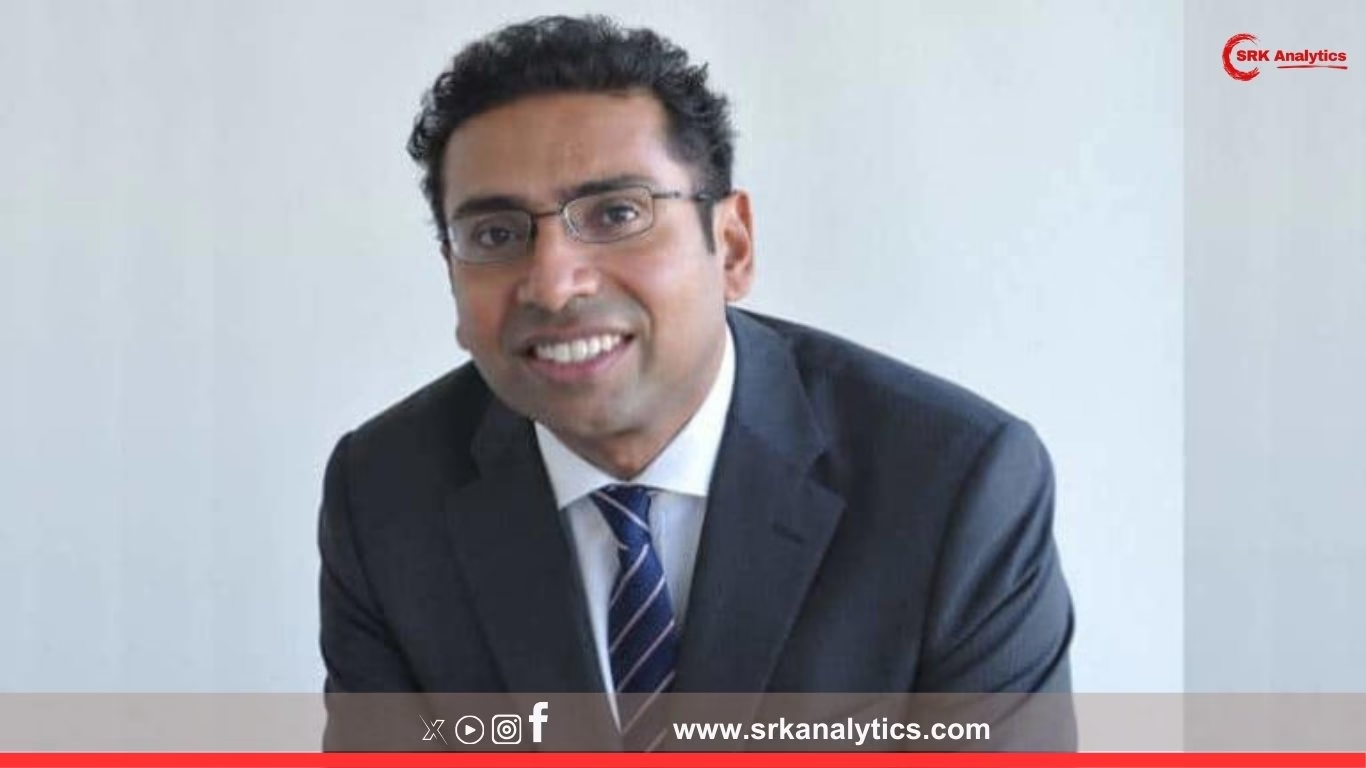
Marcellus Investment Managers founder Saurabh Mukherjea has reignited the debate on banking sector leadership, declaring that the post-COVID “downhill racing” phase is over and the time has come for the “Ferraris of banking” to pull ahead. Speaking on The Wealth Formula podcast, Mukherjea likened the easy-money era of 2020–2022 to a downhill race where even weaker lenders kept pace with high-quality banks. But as India’s economic cycle cools and asset quality pressures mount, he believes the distinction between strong and weak lenders is once again becoming visible.
Mukherjea’s metaphor underscores a broader shift in investor sentiment. With retail credit stress rising and smaller banks facing balance sheet strain, he argues that disciplined underwriting, risk-adjusted pricing, and proactive portfolio management will define the winners in the next phase of India’s banking evolution.
🧭 Banking Cycle Shift: From Downhill to Uphill
| Phase | Characteristics | Impact on Lenders |
|---|---|---|
| 2020–2022 (Downhill) | Easy liquidity, broad-based growth | Weak lenders masked by macro tailwinds |
| 2023–2025 (Uphill) | Cooling economy, rising credit stress | Quality banks begin to outperform |
| 2025 Onward (Selective) | Risk differentiation, margin compression | Strong underwriting becomes critical |
Mukherjea noted that during the post-COVID boom, even one-litre engine cars looked as fast as Ferraris. “For three years, we made no money on good lenders,” he admitted, referencing Marcellus’s quality-focused portfolios. But now, he says, “When the party ends, and it’s an uphill slope, the Ferrari pulls ahead.”
🔍 Asset Quality Divergence and Portfolio Positioning
Mukherjea highlighted the growing divergence in asset quality between top-tier banks and their weaker peers. He cited HDFC Bank, ICICI Bank, and State Bank of India as resilient players capable of navigating retail credit stress, while smaller lenders struggle with unsecured loan exposure and repayment delays.
| Bank Name | Asset Quality Trend | Portfolio Position (Marcellus) | Risk Management Approach |
|---|---|---|---|
| HDFC Bank | Stable | Large position | Early pullback from unsecured loans |
| ICICI Bank | Improving | Moderate position | Risk-based pricing, selective growth |
| Bajaj Finance | Volatile | Trimmed position | Tightened exposure since 2023 |
| Smaller NBFCs | Deteriorating | Avoided | Overexposed to risky borrower pools |
Mukherjea emphasized that quality banks reassess credit risk continuously and adjust interest rates accordingly. “If this cohort is looking risky, make sure the interest rate reflects the risk. If that leads to balance transfer out, then so be it,” he said.
📉 Retail Credit Stress and Balance Transfer Dynamics
India’s retail credit boom is showing signs of fatigue, especially in unsecured lending and tech-sector salaried segments. Mukherjea explained that top banks are proactively nudging risky borrowers out through balance transfers and repricing strategies.
| Segment | Stress Indicator | Bank Response |
|---|---|---|
| Tech Sector Salaried | Job losses, EMI delays | Higher interest rates, balance transfer |
| Unsecured Loans | Rising delinquencies | Pullback in exposure |
| Mortgages | Subdued demand | Conservative underwriting |
| MSME Lending | Mixed performance | Selective disbursement |
He contrasted this with smaller lenders that continue to offer aggressive top-ups and relaxed terms to existing borrowers, risking further deterioration in asset quality.
🔥 The Ferrari Analogy: Quality vs Quantity
Mukherjea’s “Ferrari of banking” analogy is rooted in the idea that superior risk management, capital efficiency, and underwriting discipline will drive long-term outperformance.
| Attribute | Ferrari Banks (HDFC, ICICI) | One-Litre Banks (Smaller NBFCs) |
|---|---|---|
| Underwriting Quality | High | Heuristic-based |
| Risk Pricing | Dynamic | Flat or promotional |
| Capital Allocation | Disciplined | Aggressive |
| Asset Quality | Stable | Volatile |
| Long-Term Returns | Consistent | Cyclical |
Mukherjea likened the current phase to 2015–2018, when quality lenders were re-rated while weaker peers traded below book value. “Our portfolio performance has returned. And thank God for that,” he said.
🧠 Expert Commentary and Market Sentiment
| Expert Name | Role | Comment |
|---|---|---|
| Meera Iyer | Banking Analyst | “Mukherjea’s Ferrari analogy captures the essence of quality investing.” |
| Rajiv Bansal | Credit Risk Consultant | “Balance transfer dynamics are reshaping retail lending.” |
| Dr. Rakesh Sinha | Financial Historian | “This is a classic post-boom reversion to fundamentals.” |
Analysts agree that the next phase of banking growth will be defined by selectivity, discipline, and risk-adjusted returns.
📦 Implications for Investors and Policy Makers
Mukherjea’s insights have broader implications for investors, regulators, and policymakers. As retail credit stress rises, the need for robust risk frameworks and borrower protection becomes paramount.
| Stakeholder | Strategic Action Needed |
|---|---|
| Investors | Focus on quality lenders with strong governance |
| Regulators | Monitor unsecured lending and balance transfer practices |
| Policymakers | Encourage financial literacy and responsible borrowing |
| Banks | Invest in credit analytics and risk pricing tools |
Mukherjea also cautioned against chasing the “lottery effect” in small and midcap banks, which can erode long-term returns despite short-term gains.
📌 Conclusion
Saurabh Mukherjea’s call for the “Ferraris of banking” to pull ahead marks a pivotal moment in India’s financial sector narrative. As the easy-money era fades and economic conditions tighten, quality lenders with disciplined underwriting and proactive risk management are poised to lead the next leg of growth. For investors, the message is clear: the race is uphill now, and only the best engines will endure.
—
Disclaimer: This article is based on publicly available interviews and market commentary as of September 2, 2025. It is intended for informational purposes only and does not constitute financial, legal, or investment advice.
seo агентство топ http://reiting-seo-kompaniy.ru .