



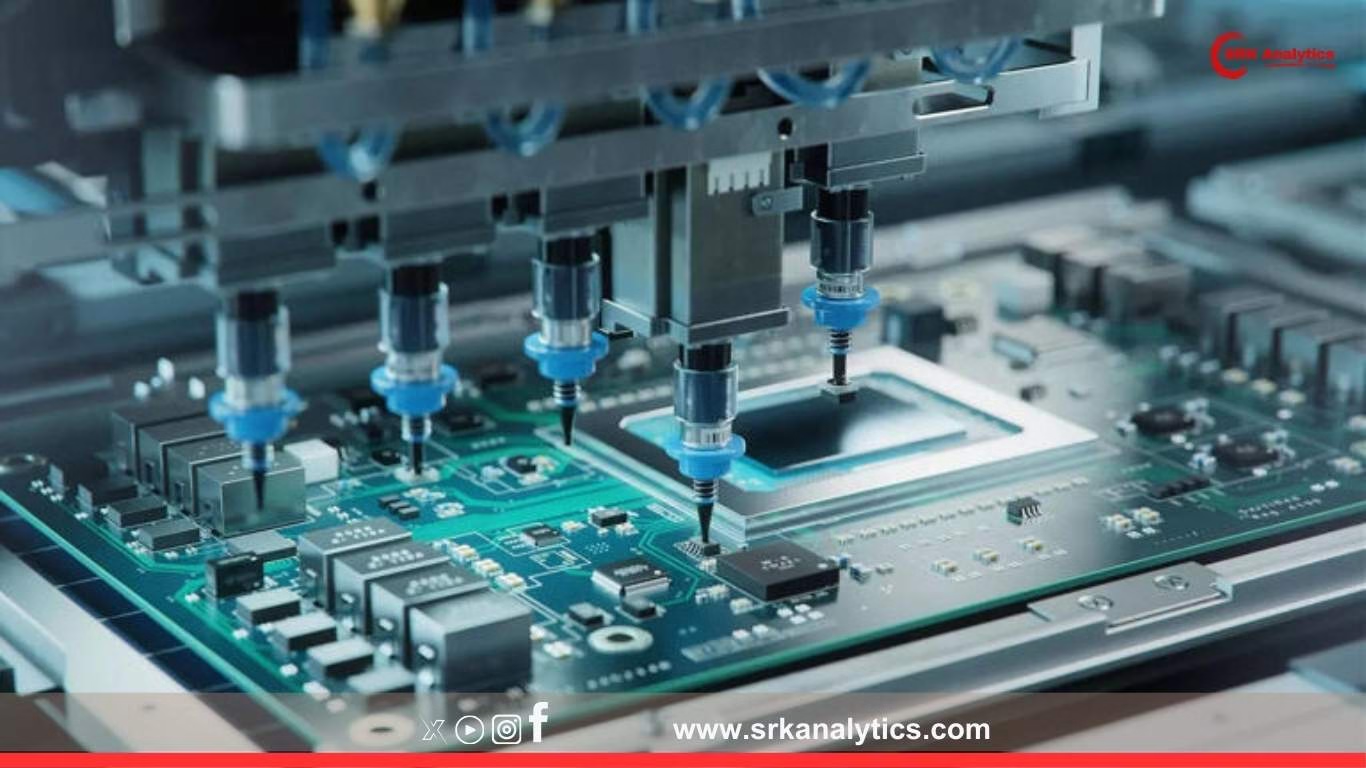
India’s ambitious push to become a global electronics manufacturing hub has received a major boost, with the Centre confirming over 150 investment proposals worth ₹19,000 crore under the Electronics Component Manufacturing Scheme (ECMS). The scheme, launched by the Ministry of Electronics and Information Technology (MeitY), aims to strengthen domestic production of critical components such as printed circuit boards (PCBs), lithium-ion cells, display modules, and passive components like resistors and capacitors.
The ₹22,919 crore ECMS was opened for applications on May 1, 2025, with an initial three-month window. Following requests from smaller manufacturers, the deadline was extended by two months, now closing on September 30. Officials have indicated that no further extensions will be granted, making this the final opportunity for stakeholders to participate in one of India’s most transformative industrial schemes.
“There has been a wave of interest from small and mid-sized manufacturers, especially in bare components like multi-layer PCBs. This is a strong signal that India’s electronics ecosystem is maturing,” said a senior MeitY official.
🧭 ECMS Application Timeline and Key Milestones
| Date | Event Description | Outcome / Impact |
|---|---|---|
| May 1, 2025 | ECMS application window opens | ₹22,919 crore scheme launched |
| July 31, 2025 | Deadline extended by two months | Boosted participation from MSMEs |
| Sept 12, 2025 | 150+ proposals worth ₹19,000 crore received | Strong industry response |
| Sept 30, 2025 | Final deadline for applications | No further extensions planned |
| Oct–Nov 2025 | Evaluation and approval of shortlisted projects | Implementation phase begins |
The scheme is expected to generate direct employment for over 91,600 individuals and catalyze production worth ₹4.56 lakh crore.
🔍 Sector-Wise Breakdown of ECMS Proposals
| Component Category | No. of Proposals | Estimated Investment (₹ crore) | Key Applicants |
|---|---|---|---|
| Printed Circuit Boards | 45 | 6,000 | IPCA members, Dixon Technologies |
| Lithium-Ion Cells | 22 | 4,200 | Wipro Electronic Materials, Tata Electronics |
| Passive Components | 38 | 3,800 | Elin Electronics, Foxconn India |
| Display Modules | 25 | 3,000 | Kunshan Q Tech, Optiemus Electronics |
| Camera Sub-Assemblies | 20 | 2,000 | Chongqing Yuhai Precision |
The Indian Printed Circuit Association (IPCA) confirmed that over 20 member companies have submitted proposals under ECMS.
📉 Challenges and Strategic Interventions
| Challenge | Description | Government Response |
|---|---|---|
| Rising Copper Clad Laminate (CCL) Prices | Imported from China, prices rising 8–9% bi-monthly | Wipro launches ₹500 crore CCL facility in Karnataka |
| Rare Earth Magnet Shortage | Export curbs by China affecting supply chain | MEA in talks with China for resolution |
| Technology Access | MSMEs lack access to advanced manufacturing tech | Joint ventures and tech transfer incentives |
| Material Sourcing | Difficulty in securing raw materials | Extended deadline to facilitate sourcing |
The government has assured industry players of continued support through diplomatic channels and domestic capacity building.
🔥 Why ECMS Is a Game-Changer for India’s Electronics Sector
- Reduces Import Dependence: India currently imports over 70% of its electronic components. ECMS aims to reverse this trend.
- Boosts MSME Participation: With a minimum revenue threshold of ₹50 crore, the scheme is accessible to mid-sized players.
- Strengthens Supply Chain: Domestic production of PCBs, lithium-ion cells, and camera modules will stabilize supply chains.
- Enhances Export Potential: Approved projects will be eligible for incentives linked to export performance.
- Supports Semiconductor Ecosystem: ECMS complements India’s semiconductor mission by building upstream component capacity.
Industry bodies like Elcina estimate that India’s component demand-supply gap could reach ₹21 lakh crore by 2030.
🧠 Expert Commentary on ECMS Impact
| Expert Name | Role | Comment |
|---|---|---|
| Meera Iyer | Electronics Policy Analyst | “ECMS is the missing link in India’s electronics value chain.” |
| Rajiv Bansal | Manufacturing Consultant | “The scheme’s design is inclusive and forward-looking.” |
| Dr. Rakesh Sinha | Historian of Indian Industry | “This is a defining moment for India’s industrial self-reliance.” |
Experts agree that ECMS will accelerate India’s transition from an assembly hub to a full-fledged manufacturing powerhouse.
📦 ECMS Scheme Snapshot
| Parameter | Details |
|---|---|
| Scheme Name | Electronics Component Manufacturing Scheme (ECMS) |
| Total Outlay | ₹22,919 crore |
| Application Window | May 1 – Sept 30, 2025 |
| Target Segments | PCBs, Li-ion cells, passive components, display modules |
| Minimum Revenue Criteria | ₹50 crore for applicants |
| Employment Target | 91,600 direct jobs |
| Production Target | ₹4.56 lakh crore |
The scheme is part of India’s broader electronics strategy, which includes PLI schemes and semiconductor incentives.
📅 Upcoming ECMS Milestones
| Event | Date | Strategic Importance |
|---|---|---|
| Final Application Deadline | Sept 30, 2025 | Last chance for manufacturers to apply |
| Project Evaluation Phase | Oct–Nov 2025 | Shortlisting and approvals |
| Implementation Kickoff | Dec 2025 | Groundbreaking of approved facilities |
| First Production Rollout | Q2 2026 | Domestic supply begins |
The government is expected to announce the first batch of approved projects in November 2025.
📌 Conclusion
With over 150 proposals worth ₹19,000 crore received under the Electronics Component Manufacturing Scheme, India’s vision to become a global electronics manufacturing hub is gaining momentum. The ECMS not only promises to reduce import dependence but also empowers MSMEs, strengthens supply chains, and creates thousands of jobs. As the September 30 deadline approaches, the scheme stands as a cornerstone of India’s industrial transformation—one component at a time.
—
Disclaimer: This article is based on publicly available government announcements, industry reports, and expert commentary as of September 12, 2025. It is intended for informational purposes only and does not constitute investment or legal advice.