




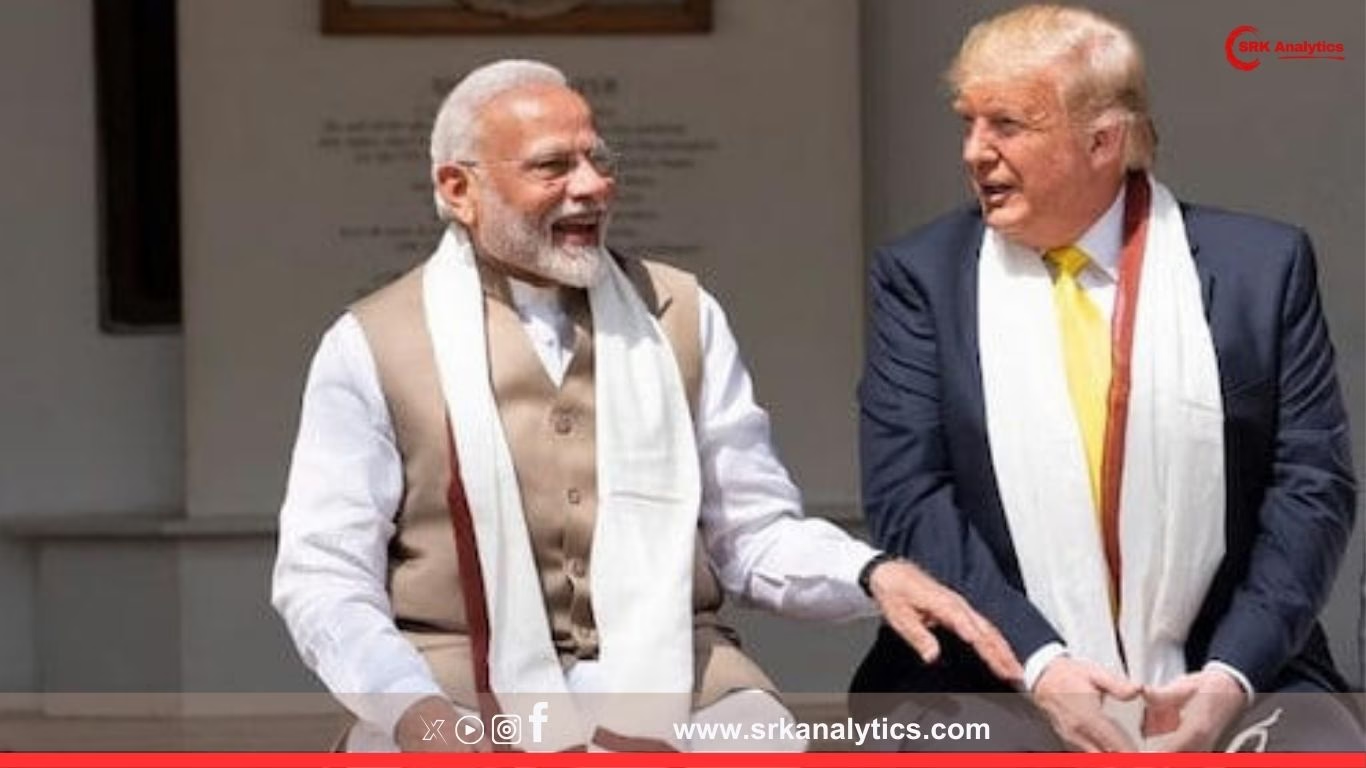
India’s Chief Economic Advisor (CEA) V. Anantha Nageswaran has signaled a potential breakthrough in the ongoing trade dispute with the United States, suggesting that the additional 25% export duty imposed on Indian goods could be withdrawn within the next 8 to 10 weeks. Speaking at industry events in Kolkata, Nageswaran expressed cautious optimism, stating that “beneath the surface, conversations are going on between the two governments,” and that a resolution may be in sight by November 30, 2025.
The penal tariffs, which were levied in August 2025 under the International Emergency Economic Powers Act (IEEPA), were a retaliatory measure by the U.S. administration in response to India’s continued purchase of Russian crude oil. The move doubled the duty on Indian exports to 50%, triggering widespread concern across export-driven sectors such as textiles, gems and jewellery, chemicals, and footwear.
Timeline of U.S.–India Tariff Dispute
| Date | Event |
|---|---|
| August 1, 2025 | U.S. imposes 25% reciprocal tariff on Indian goods |
| August 6, 2025 | Additional 25% penalty announced, raising total to 50% |
| August 7, 2025 | Tariffs come into effect |
| September 16, 2025 | Bilateral trade talks resume in New Delhi |
| September 18, 2025 | CEA Nageswaran signals possible resolution within 8–10 weeks |
The trade tensions have cast a shadow over India-U.S. economic relations, but recent developments suggest a renewed commitment to dialogue and resolution.
Key Highlights from CEA Nageswaran’s Remarks
| Statement | Context |
|---|---|
| “I do believe the penal tariff will not be there after Nov 30.” | On expected timeline for resolution |
| “My personal feeling is we will see a solution in 8–10 weeks.” | On ongoing negotiations |
| “This issue affects capital formation and sentiment.” | On broader economic implications |
| “Reciprocal tariffs may fall to 10–15%.” | On potential outcomes of trade talks |
Nageswaran emphasized that while he has no insider information, his confidence stems from the tone of recent bilateral engagements and the urgency shown by both sides.
Impact of Tariffs on Indian Exports
| Sector | Estimated Loss (Aug–Sept 2025) | Key Exports Affected |
|---|---|---|
| Textiles | ₹4,200 crore | Cotton garments, home furnishings |
| Gems & Jewellery | ₹3,800 crore | Cut and polished diamonds, gold jewellery |
| Chemicals | ₹2,500 crore | Organic chemicals, pharmaceuticals |
| Footwear | ₹1,100 crore | Leather shoes, sportswear |
| Total Export Loss | ₹11,600 crore | Across all sectors |
India’s exports to the U.S. reached $86.51 billion in FY25, making the U.S. India’s largest export destination. The sudden imposition of 50% tariffs disrupted supply chains and dampened sentiment among exporters.
India–U.S. Trade Negotiation Framework
| Negotiation Lead – India | Rajesh Agrawal, Special Secretary, Department of Commerce | | Negotiation Lead – U.S. | Brendan Lynch, Assistant U.S. Trade Representative | | Current Focus | Bilateral Trade Agreement (BTA), tariff rollback, Russian oil clause | | Rounds Held | 5 completed, 6th postponed due to tariff escalation | | Next Milestone | Draft resolution expected by late October 2025 |
The resumed talks in New Delhi on September 16 marked the first high-level engagement since the tariff escalation. Both sides have committed to accelerating negotiations and reaching a mutually beneficial agreement.
Potential Outcomes of Tariff Resolution
| Scenario | Implication |
|---|---|
| Full rollback of 25% penalty | Immediate relief for exporters, restoration of trade volumes |
| Reduction to 10–15% | Partial relief, improved competitiveness |
| No change | Continued strain on bilateral trade, risk of WTO escalation |
Nageswaran hinted that a reduction to 10–15% is being considered, which would still mark a significant improvement over the current 50% duty.
Broader Economic Context
| Indicator | Value |
|---|---|
| India’s Q1 FY26 GDP Growth | 7.8% |
| Projected Q2 FY26 Growth | ~7% |
| Annual Export Target | $850 billion |
| Export Share of GDP | 25% |
Despite trade headwinds, India’s economy continues to show resilience, driven by manufacturing, services, and urban consumption. Nageswaran noted that resolving the tariff issue is critical for sustaining this momentum.
Industry Response and Outlook
| Industry Body | Reaction |
|---|---|
| Federation of Indian Export Organisations (FIEO) | Welcomed CEA’s remarks, urged swift action |
| Apparel Export Promotion Council (AEPC) | Called for immediate rollback to protect jobs |
| Gem & Jewellery Export Promotion Council (GJEPC) | Warned of long-term reputational damage |
| Confederation of Indian Industry (CII) | Advocated for strategic trade diplomacy |
Exporters have expressed cautious optimism, hoping that the government’s proactive stance will translate into tangible relief before the peak festive season.
Conclusion: A Critical Window for Trade Diplomacy
CEA V. Anantha Nageswaran’s remarks offer a glimmer of hope for Indian exporters reeling under the weight of steep U.S. tariffs. With bilateral negotiations back on track and both governments signaling intent to resolve the dispute, the next 8 to 10 weeks could prove pivotal.
A rollback or reduction of the 25% penal duty would not only restore trade flows but also reaffirm the strength of India-U.S. economic ties. As exporters await clarity, the spotlight remains on diplomatic agility, strategic engagement, and the shared goal of fostering a fair and open global trade environment.
—
Disclaimer: This article is based on publicly available government statements, verified news reports, and trade data. It is intended for informational purposes only and does not constitute legal, financial, or policy advice. All negotiations and tariff decisions are subject to change based on official announcements.