




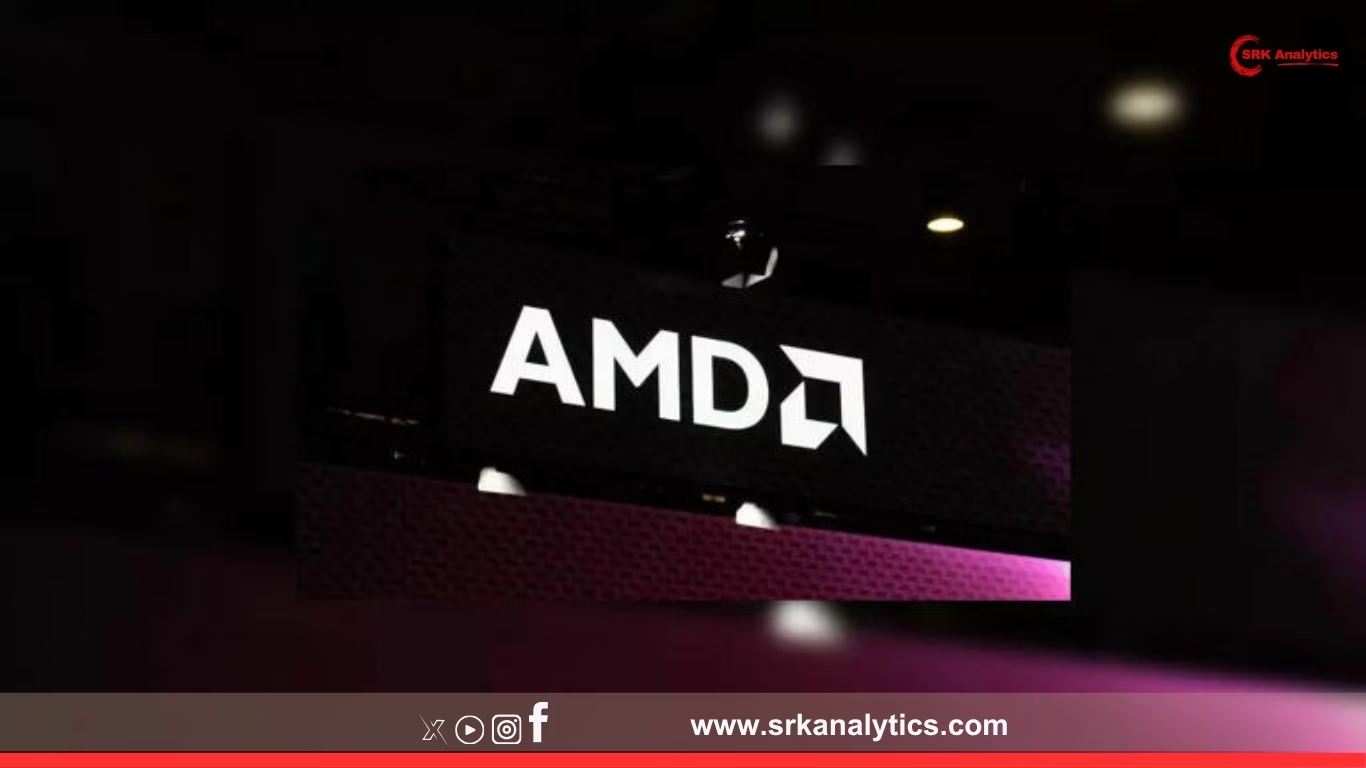
Advanced Micro Devices (AMD) has issued a terse one-line response to swirling media reports suggesting early-stage discussions with rival Intel Corporation over a potential chip manufacturing partnership. The statement, released on October 3, 2025, simply read: “AMD does not comment on rumor or speculation.” Despite its brevity, the response has ignited intense debate across the semiconductor industry, with analysts dissecting the implications of what could be a historic realignment between two of the world’s most prominent chipmakers.
The speculation began in late September and gained momentum after a report from Semafor claimed that AMD was exploring the possibility of outsourcing some of its chip production to Intel Foundry Services (IFS)—Intel’s contract manufacturing arm. The move, if confirmed, would mark a dramatic shift in industry dynamics, given AMD’s long-standing reliance on Taiwan Semiconductor Manufacturing Company (TSMC) and its fierce rivalry with Intel in the x86 processor market.
AMD–Intel Manufacturing Rumours – Timeline of Developments
| Date | Event Description | Commentary |
|---|---|---|
| Sep 28, 2025 | Initial speculation surfaces | Industry insiders hint at talks |
| Oct 1, 2025 | Semafor publishes report on AMD–Intel talks | Describes discussions as “early stage” |
| Oct 3, 2025 | AMD issues one-line response | Dismisses reports as “rumours” |
| Oct 3, 2025 | Intel shares surge 7%, AMD up 1% | Market reacts to potential partnership |
Intel’s Foundry Services, launched under its IDM 2.0 strategy, aims to position the company as a global contract manufacturer for external clients. Securing AMD as a customer would be a major validation of Intel’s turnaround efforts, especially after recent investments from the US government, Nvidia, and SoftBank.
For AMD, the potential partnership could offer strategic diversification of its supply chain, reducing dependence on TSMC amid rising geopolitical risks in East Asia. However, outsourcing chip production to its primary competitor raises questions about trust, confidentiality, and long-term strategic alignment.
AMD’s Current Manufacturing Strategy – Key Suppliers
| Supplier Name | Role in AMD’s Supply Chain | Commentary |
|---|---|---|
| TSMC | Primary foundry for advanced nodes | Manufactures Ryzen, EPYC, Radeon chips |
| GlobalFoundries | Legacy node support | Used for older or embedded products |
| Intel Foundry Services | Rumoured new partner | Would mark first-ever collaboration |
Industry analysts remain divided. Some view the potential deal as a pragmatic move by AMD to ensure supply chain resilience, while others warn of risks associated with sharing sensitive design data with a direct competitor. “If AMD goes ahead, it signals a new era of cooperation in the semiconductor space. But it also raises serious questions about IP protection and strategic autonomy,” said Dr. Lisa Huang, semiconductor analyst at Bernstein Research.
Intel, for its part, has not issued a formal statement but is widely believed to be actively courting major clients for its foundry business. The company’s shares rose 7% following the reports, while AMD gained over 1%, reflecting investor optimism about the potential synergies.
Market Reaction – Semiconductor Stocks (Oct 3, 2025)
| Company Name | Sector | Stock Movement (%) | Commentary |
|---|---|---|---|
| Intel Corporation | Foundry/Chipmaker | +7.0% | Boosted by AMD partnership rumours |
| AMD | Chipmaker | +1.2% | Investors weigh supply chain strategy |
| TSMC | Foundry | -0.8% | Concerns over client diversification |
| Nvidia | AI/GPUs | +2.5% | Indirect beneficiary of Intel’s rebound |
| GlobalFoundries | Foundry | +0.6% | Potential alternative for AMD |
The broader implications of such a partnership could reshape the competitive landscape. Intel’s IDM 2.0 strategy has struggled to attract marquee clients, and AMD’s involvement would be a game-changer. It would also signal that Intel’s fabrication technology is mature enough to handle high-performance workloads traditionally entrusted to TSMC.
Open questions remain about the scope of the potential deal. Would AMD outsource high-end processors like Ryzen and EPYC, or limit the partnership to mature nodes and embedded components? Would Intel offer competitive pricing and yield guarantees? And how would regulators view such a collaboration between two dominant players in the x86 space?
Potential AMD–Intel Partnership Scenarios
| Scenario Description | Strategic Implications | Risk Factors |
|---|---|---|
| High-end chip outsourcing | Major validation for Intel Foundry | IP protection, performance benchmarks |
| Mature node collaboration | Low-risk diversification for AMD | Limited impact on Intel’s turnaround |
| Joint R&D or packaging | Innovation in advanced packaging | Complex integration, competitive tension |
| No deal – talks collapse | Status quo maintained | Missed opportunity for both firms |
AMD’s one-line response has done little to quell speculation. While the company maintains its policy of not commenting on rumours, the timing and context of the statement suggest that discussions may be ongoing behind closed doors. The semiconductor industry, known for its secrecy and strategic maneuvering, often sees deals materialize months after initial denials.
Social media platforms and investor forums have been abuzz with reactions, with hashtags like #AMDIntel, #ChipWars, and #FoundryShift trending across Twitter/X, LinkedIn, and Reddit.
Public Sentiment – Social Media Buzz on AMD–Intel Rumours
| Platform | Engagement Level | Sentiment (%) | Top Hashtags |
|---|---|---|---|
| Twitter/X | 1.5M mentions | 78% speculative | #AMDIntel #ChipWars #FoundryShift |
| 1.2M interactions | 82% strategic | #SemiconductorStrategy #IDM2.0 | |
| 950K views | 85% analytical | #TechRumours #AMDIntelDeal | |
| YouTube | 870K views | 80% curious | #AMDExplained #IntelFoundry |
In conclusion, AMD’s brief dismissal of chip manufacturing partnership rumours with Intel has only intensified curiosity and speculation. Whether the two rivals will forge a groundbreaking alliance or maintain their competitive distance remains to be seen. For now, the semiconductor world watches closely, as even a single line can shift market sentiment and strategic trajectories.
Disclaimer: This article is based on publicly available financial reports, verified media coverage, and official company statements. It does not constitute investment advice or confirmation of any corporate deal. All quotes are attributed to public figures and institutions as per coverage. Readers are advised to follow official filings and disclosures for verified information.