

Aditya Birla Capital, one of India’s leading diversified financial services providers, has unveiled its whitepaper, ‘Agentic AI for Bharat’s BFSI: A Practitioner’s View’ at the Global Fintech Fest 2026. The whitepaper examines how the next phase of AI adoption can move beyond isolated automation to enable deeper financial participation, make financial services more contextual, responsive, and augment human capabilities across the BFSI ecosystem.
 |
Aditya Birla Capital unveils ‘Agentic AI for Bharat’s BFSI: A Practitioner’s View’
Click here to download the whitepaper
The whitepaper presents a fundamental shift in financial inclusion, from providing access to the depth of offering. With access to financial services having expanded significantly, the next frontier lies in helping customers understand, adopt and appropriately use products that are relevant to their financial needs.
The whitepaper also explores how Agentic AI can make personalised guidance, engagement, onboarding and servicing more economically viable at scale, enabling financial institutions to reach wider customer segments and serve them better.
Mr. Pankaj Gadgil, MD & CEO, Aditya Birla Housing Finance Limited and Head, Digital Platforms and Payments Strategy, Aditya Birla Capital, said, “Our vision is to build a future-ready, scalable enterprise where intelligence, foresight, and customer-first approach drive decision making. Through our AI-first strategy, we are simplifying customer journeys, accelerating product innovation, automating underwriting, enhancing service delivery, and delivering greater operational efficiency. Responsible AI is a core enterprise capability for us to drive sustainable scale, trust, and resilience. As we evolve from individual AI use cases to enterprise-wide connected intelligence, robust governance, human accountability, and customer trust will remain fundamental to how we innovate, grow, and create long-term value for all stakeholders.”
Drawing from Aditya Birla Capital’s experience, the whitepaper presents eight areas of Agentic AI deployment across the enterprise, from orchestration of customer journeys, tele-sales and cross-sell, top-of-funnel engagement, customer service and retention, sales coaching, marketing and personalisation, software development, and audit, finance, investment and compliance. Several of these initiatives are already operating in production and demonstrate how AI can be embedded into end-to-end workflows rather than deployed as standalone point solutions.
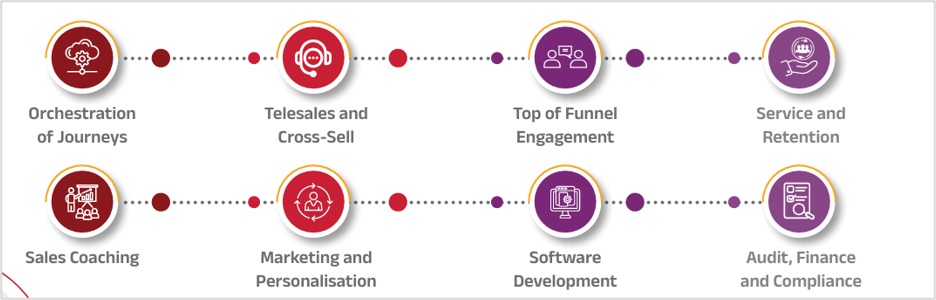 |
Agentic AI in Action: Areas of Deployment at Aditya Birla Capital
A central proposition of the whitepaper is that the value of Agentic AI should be measured not just through efficiency gains, but through its ability to deepen financial participation and augment human capacity to potentially serve more customers. It examines what it takes to move from AI experimentation to responsible enterprise-scale deployment. It highlights the importance of trusted data, connected systems, workflow redesign, workforce readiness and clearly defined human decision rights. It also highlights responsible AI practices including traceability, monitoring, accountability, security and data protection by design.
At the Global Fintech Fest 2026, Aditya Birla Capital won the ‘Best Digital Transformation Program’ award under Excellence in Banking Technology for its use of Generative AI, intelligent automation and real-time data insights to streamline processes, enhance customer experience, and make finance simpler, smarter and more connected.
Through ‘Agentic AI for Bharat’s BFSI: A Practitioner’s View,’ Aditya Birla Capital brings together its experience and learnings from scaling AI across the enterprise, offering a practitioner’s perspective on how financial institutions can build the capabilities required to move from individual AI use cases to responsible, scalable deployment, with customer outcomes and human judgement at the core.
Aditya Birla Capital Limited and its subsidiaries/JVs provide a comprehensive suite of financial solutions across Loans, Investments, Insurance, and Payments to serve the diverse needs of customers across their lifecycles. Powered by over 66,500 employees, the businesses of ABCL have a nationwide reach with over 1,759 branches and more than 200,000 agents/channel partners along with several bank partners. ABCL and its subsidiaries/JVs manage aggregate assets under management of about Rs. 7.53 Lakh Crore, and the consolidated lending book crossed Rs. 2.19 Lakh Crore as of June 30, 2026 www.adityabirlacapital.com.