
Crompton Greaves Consumer Electricals Ltd., one of India’s leading consumer electrical companies, last week unveiled its new Master Brand identity, marking the next chapter of Crompton 2.0; the company’s strategic transformation into an innovation-led consumer-centric business. Over the last decade, Crompton has strategically expanded beyond its core categories through sustained investments in technology and product innovation. The new brand identity reflects this business evolution, creating a unified platform while supporting the company’s next phase of innovation, premiumisation and long-term growth.
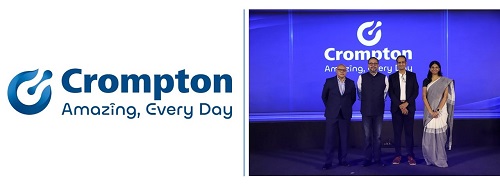 |
Crompton New Logo | L-R: Tanmay Prusty, CMO; Promeet Ghosh, MD & CEO; Kaleeswaran Arunachalam, Group CFO & Head of Strategy; Shweta Sagar, CBO, Butterfly & PL Head – Rhion
At the heart of Crompton’s refreshed identity is “Cephyr” (pronounced SAF-FYR), the Crompton Greaves Consumer Electricals Ltd.’s new emblem and primary visual expression. The name Cephyr draws inspiration from two powerful sources, the deep, enduring blue of sapphire and the gentle breeze of Zephyrus, the Greek wind. It reflects care, quality, refinement and timelessness with effortless grace and quiet energy. Cephyr, is symbolic of Crompton’s transformation into a design-forward brand, where fluidity, adaptability, and aesthetic sophistication define every touchpoint. The emblem carries deep meaning: The ‘C’ stands for Consumer, Customer, Care, Connectivity and Crompton, highlighting the brand’s commitment to consumer-centric innovation and connected living experiences. The graceful upward curve at the C’s tip conveys the brand’s commitment to responsibility and continuous elevation. The infinity symbol that emerges from within the C and rises outward, reflects Crompton’s journey of going beyond boundaries while continuously ascending toward innovation.
The construction of Cephyr using twelve circles is equally meaningful, each representing a month of the year, symbolizing how Crompton moves through seasons with consumers, cooling scorching summers, warming chilly winters, lighting festivals and powering daily rituals. The circular, flowing construction mirrors the cyclical nature of seasons and Crompton’s fluid ability to adapt, always meeting consumers exactly where they are, all year round.
Accompanying Cephyr is Crompton’s new brand promise: ‘Amazing, Every Day.‘ This tagline is far more than words; it’s a commitment to transform the ordinary rhythm of daily life into something extraordinary through thoughtful innovation and unwavering dependability. ‘Amazing’ represents meaningful moments of delight and seamless experiences that genuinely elevate everyday living. Not theatrical extravagance, but thoughtful enhancements that make life feel tangibly better, easier, and more enjoyable. ‘Every Day’ embodies dependability and constant presence, a promise that Crompton delivers value and enrichment in the natural rhythm of daily life. The tagline features intentional design details that reinforce Crompton’s brand story. The ‘i’ in Amazing has been subtly modified to echo the Wi-Fi symbol, representing Crompton’s commitment to intelligent, smart and connected ecosystems. The ‘E’ in Every Day carries a refined design element inspired by the Electrical Plug and Power Button symbol, a thoughtful homage to Crompton’s 85+ year electrical heritage and its core identity rooted in powering Indian homes.
Complementing the visual transformation is a distinctive sonic identity that creates an auditory signature for the brand. This sonic branding will enhance recognition and recall across consumer touchpoints, from advertisements and digital platforms to product experiences and retail environments—creating a cohesive multisensory brand experience.
Promeet Ghosh, Managing Director & CEO, Crompton Greaves Consumer Electricals Ltd., said, “The home solutions industry is entering a defining phase of transformation where everyday living is simplified through thoughtful innovation, seamless experiences and solutions they can trust. We believe the strongest brands of tomorrow won’t be defined by a single category, but by the role they play across consumers’ everyday lives. That belief has shaped Crompton 2.0—our strategic transformation into a diversified, innovation-led home solutions business. Over the past decade, we have expanded beyond our legacy categories, strengthened our innovation capabilities and built a portfolio that responds to the evolving needs of Indian consumers, while remaining anchored in the trust that has defined Crompton for over 85 years. Our new brand identity is far more than a visual change. From introducing Cephyr the new emblem, the new tagline, along with a distinctive sonic identity, we are creating a future-ready identity for Crompton. More than a new identity, it reinforces our ambition and belief to build deeper consumer preference, accelerate our premiumisation journey and create long-term value for our consumers, partners and shareholders.”
Tanmay Prusty, Chief Marketing Officer, Crompton Greaves Consumer Electricals Ltd., said, “Crompton has evolved significantly over the years, and our new brand identity reflects that transformation. It is a unified brand system encompassing our visual and sonic identity, designed to create a more distinctive consumer experience. At the same time, we are building a stronger platform of brands to address evolving consumer needs across different segments.”
The new Master Brand will be progressively rolled out across Crompton’s products, packaging, retail presence, digital platforms and consumer communications, creating a consistent brand experience across every consumer touchpoint.
As Crompton expanded into new categories and consumer segments, it was recognized that a single-brand approach would not always address increasingly diverse consumer needs. Crompton Greaves Ltd’s branded platforms enable the organization to build distinct propositions, while leveraging the trust and equity of the Crompton name. CGCEL’s Energion represents an intelligent energy platform, designed to address the evolving energy landscape that is moving beyond standalone products to integrated energy ecosystems. Energion’s brand promise: “The Power Behind Everyday Progress” positions it as a trusted partner that enables consumers and businesses through reliable, intelligent and sustainable energy solutions. The name ‘Energion’ is derived from ‘Energy’, the fundamental particle that enables the flow of electricity, representing the intelligent movement, storage and application of energy, powering homes, businesses and everyday life. Energion plays across the entire energy value chain from generation to conversion to storage to charging solutions. This future-ready platform is not locked to any category, allowing Crompton to participate in emerging energy adjacencies while maintaining premium yet accessible positioning.
As part of its premiumization strategy, Crompton today introduced Crompton Rhion, its new super-premium brand, marking the next phase of the company’s growth journey. Positioned as a brand for consumers seeking elevated modern living, Rhion brings together purposeful innovation, technical mastery and elegant design to deliver refined, intuitive experiences.
Promeet Ghosh, Managing Director & CEO, Crompton Greaves Consumer Electricals Ltd. said, “The launch of Crompton Rhion marks an important milestone in our premiumization journey and reflects our ambition to strengthen our presence in the super-premium segment. As our dedicated super-premium brand, Crompton Rhion will enable us to deliver elevated experiences through thoughtful design, advanced technology and solutions that cater to the evolving aspirations of consumers. Crompton Rhion combines technical mastery with intuitive innovation to deliver a new benchmark in premium living.”
Crompton Rhion is built on the philosophy of ‘Prowess Inside. Poise Outside.”; representing the perfect balance between sophisticated exterior design and purposeful internal innovation. This philosophy ensures that every Crompton Rhion product delivers invisible mastery in engineering while presenting visible elegance in form. Crompton Rhion’s innovation philosophy combines next-generation technology with human-centric design to create intuitive experiences tailored to evolving consumer needs. Crompton Rhion makes its debut in the premium water purification category with the launch of the Crompton Rhion Water Biofier, a category-first innovation that provides water the way it’s meant to be for people.
The launch comes at a time when India’s domestic electric water purifier market is estimated at approximately INR 5,565 crore, with reverse osmosis (RO) accounting for nearly 85% of the category. Despite the category’s scale, household penetration remains at just 6%, highlighting significant headroom for long-term growth and continued premiumization. The Crompton Rhion Water Biofier represents a fundamental rethinking of water purification, moving beyond conventional approaches to deliver water that is not just pure, but optimally balanced for human consumption. This innovation embodies Rhion’s commitment to combining prowess in engineering with poise in experience.
About Crompton
With a brand legacy of over 85 years, Crompton Greaves Consumer Electricals Ltd. is India’s market leader in the category of fans and residential pumps. Over the years, the organization has continuously strived to produce a range of innovative products that cater to the modern consumer including superior quality and high-performance fans, pumps, lighting solutions, and a range of other categories like water heaters; air coolers; small kitchen appliances like mixer grinders, air fryers, OTG, electric kettles etc; other home appliances like irons & built-in kitchen appliances. The company has further invested in brand and innovation to not only better understand and meet consumer needs but to also help drive energy efficiency. The consumer business also has a well-established and organized distribution network driven by a strong dealer base across the country offering a wide service network and robust after-sales service to its customers. Beyond its consumer portfolio, Crompton also has a robust B2B presence in the Lighting segment, delivering advanced and energy-efficient solutions for commercial and industrial applications. In 2025, Crompton became the first lighting company to receive the GreenPro certification for its B2B lighting solution, reaffirming its commitment to sustainability and innovation. Strengthening its foothold in the renewable energy space, the company has forayed into solar rooftops—representing a significant step forward in its contribution to India’s evolving clean energy landscape. With solar solutions spanning lighting, pumps, and rooftops, Crompton continues to lead as a responsible and future-ready brand in sustainable energy.
The company’s consistent dedication to developing energy-efficient products has led to significant recognition. It has been honored with three prestigious National Energy Consumer Awards (NECA) by BEE, Ministry of Power. The recent award was presented by the Hon’ble President of India, Smt. Droupadi Murmu for the company’s storage water heater in 2023. In 2019, the brand won in two categories: Ceiling Fans and LED Bulbs. Additionally, it was recognized as one of India’s Best Managed Companies 2022 by Deloitte Private and listed among ‘India’s Top 500 Companies 2022’ by Dun & Bradstreet India. The company has also been featured in Brand Top 75 most valuable Indian brands list for 2020 released by WPP and Kantar. Furthermore, Crompton was also recognized as the Brand of the Decade 2021 by Herald Global and BARC Asia in the Consumer Electrical category.