
Marking World Entrepreneurship Day, M3M Foundation announced the digital expansion of its VyaPower Entrepreneurship Development Programme (EDP) with the launch of a dedicated Learning Management System (LMS), aimed at taking structured and practical entrepreneurship education to aspiring entrepreneurs, rural women, youth, micro-enterprise owners and communities across India.
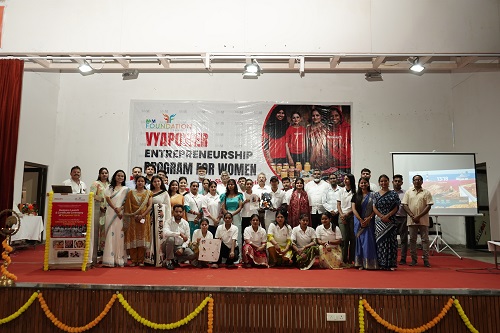 |
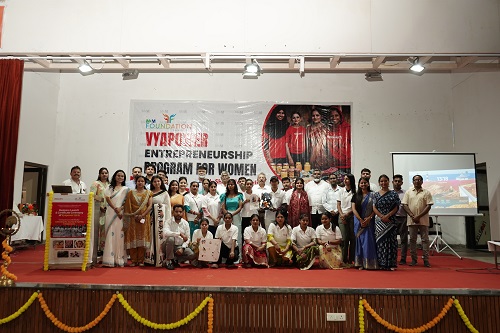
M3M Foundation team and women entrepreneurs at the launch of the VyaPower Entrepreneurship Programme
The digital platform, being developed with the support of Fundink, represents the next phase of VyaPower, M3M Foundation’s entrepreneurship development initiative designed to help individuals move from aspiration to enterprise and from enterprise to sustainable livelihoods.
Through the LMS, learners will be able to access structured, self-paced entrepreneurship training anytime and from anywhere. The digital format is particularly intended to overcome barriers of geography, time and access that often prevent aspiring entrepreneurs, especially women and youth in rural and underserved communities, from participating in conventional classroom-based programmes.
From Ideas to Sustainable Enterprises
VyaPower has been conceptualised as more than a training programme. It seeks to build an entrepreneurship development ecosystem that equips individuals with the practical knowledge, skills and confidence required to transform an idea, skill or livelihood activity into a viable enterprise.
The curriculum covers key stages of the entrepreneurial journey, including development of an entrepreneurial mindset, identification of business opportunities, business planning, understanding customers and markets, costing and pricing, financial management, marketing and branding, digital opportunities and strategies for managing and growing sustainable enterprises.
The initiative has already progressed through its capacity-building phase, including an intensive Training of Trainers (ToT) programme to create a pool of facilitators capable of taking entrepreneurship learning deeper into communities. The programme follows an idea-to-implementation approach, enabling participants to move beyond theoretical learning towards practically developing their business ideas.
The LMS will now allow this learning framework to be standardised, digitised and delivered at a much larger scale, while also enabling systematic learner engagement and progress tracking.
Empowering Rural Women and Grassroots Entrepreneurs
A key focus of VyaPower is to make entrepreneurship education accessible to rural and semi-urban women, including members of Self-Help Groups, community collectives, livelihood programmes and women already operating small or home-based enterprises.
Across communities, many women possess valuable skills, produce marketable products or have viable business ideas, but often lack access to financial literacy, business planning, branding, market knowledge and enterprise management support.
Through VyaPower, M3M Foundation seeks to help women transition from livelihood participants to entrepreneurs, producers and potential job creators, strengthening both household incomes and local economies.
Open to NGOs, Institutions and Community Organisations
Importantly, M3M Foundation is opening the VyaPower ecosystem to NGOs, educational institutions, SHGs, community-based organisations, livelihood organisations and other institutions that are working with aspiring entrepreneurs.
Such organisations can approach M3M Foundation to explore access to the VyaPower learning framework, capacity-building support and the Train-the-Trainer model, enabling them to take structured entrepreneurship education to their own communities and beneficiaries.
This collaborative model is expected to create a multiplier effect, where trained facilitators can support several aspiring entrepreneurs and, over time, successful entrepreneurs can create livelihoods and employment for others within their communities.
Technology to Take Entrepreneurship to the Last Mile
The LMS being developed with Fundink will serve as the digital backbone of VyaPower, enabling self-paced learning, structured progression across modules, standardisation of training content, learner progress tracking and integration of digital and community-based training.
Speaking on the launch, Dr. Payal Kanodia, Chairperson and Trustee, M3M Foundation, said, “India has tremendous entrepreneurial aspiration, particularly among its youth and women. What is often missing is access to structured knowledge, confidence, mentoring and the right ecosystem. Through VyaPower, we want to bridge this gap and enable people to translate their skills and ideas into sustainable enterprises.”
“Digitalisation will allow us to take this knowledge far beyond the boundaries of a classroom. More importantly, we invite NGOs, institutions and grassroots organisations to partner with us and take VyaPower into their communities. Our larger ambition is to create a multiplier ecosystem of trainers, entrepreneurs and eventually job creators across India.”
The launch on World Entrepreneurship Day reinforces M3M Foundation’s belief that entrepreneurship can be a powerful driver of economic independence, dignity and local development. Through digital learning, capacity building and institutional partnerships, VyaPower aims to create a scalable platform that empowers individuals not only to seek opportunities, but to create enterprises, generate livelihoods and become job creators.
VyaPower — Powering Ideas. Creating Enterprises. Transforming Lives.
About M3M Foundation
M3M Foundation is the philanthropic and social development arm of M3M Group, working towards sustainable and inclusive development through interventions spanning education, livelihoods and entrepreneurship, healthcare, environment, sports and community development. The Foundation works with communities and partners to build capabilities, create opportunities and enable people to become increasingly self-reliant.