





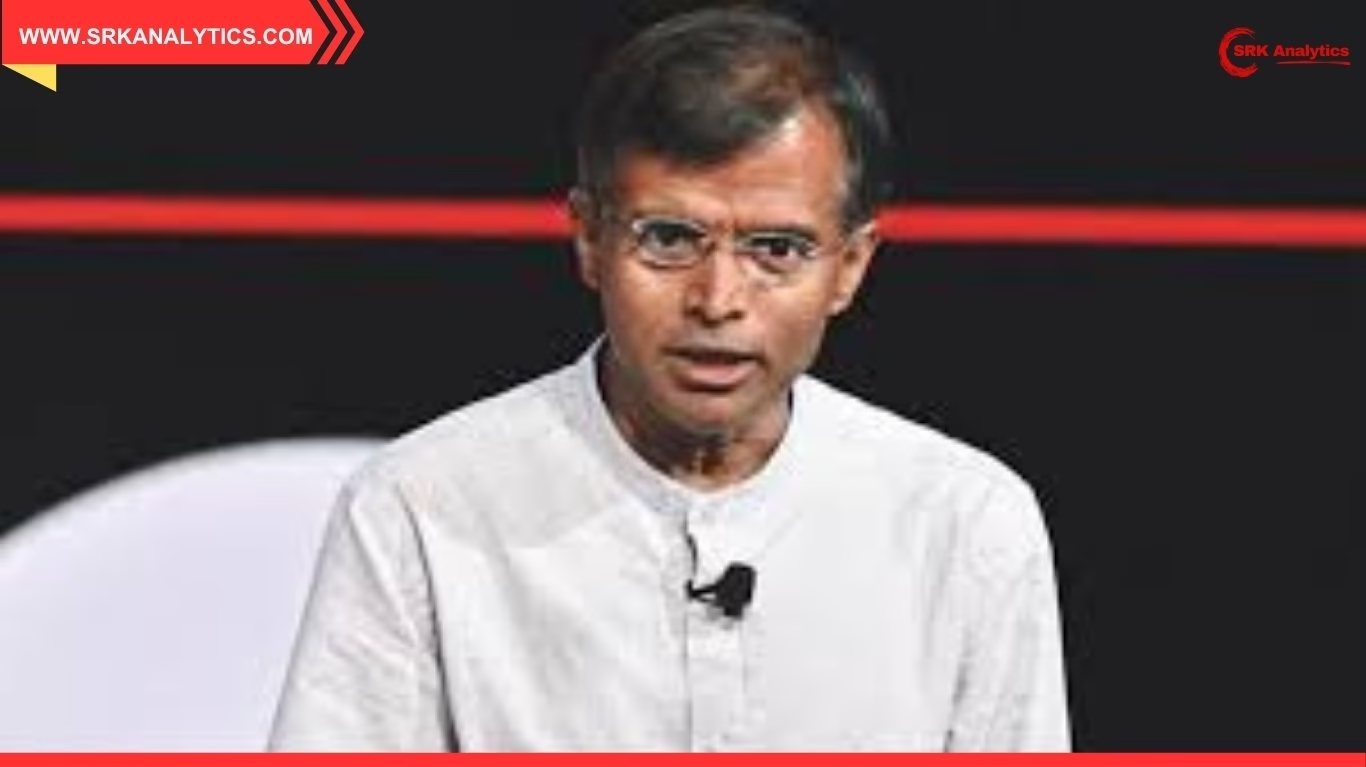
Renowned valuation expert and NYU Stern professor Aswath Damodaran has issued a nuanced take on India’s economic trajectory, stating that while the country’s growth story is compelling, it is fundamentally different from China’s. Speaking on a podcast with ET BFSI and in a recent interview with Business Today, Damodaran emphasized that India’s democratic structure, policy unpredictability, and market overvaluation present unique challenges that investors must not ignore.
“India’s story has legs, but it’s not like China,” Damodaran said, cautioning that expectations of uninterrupted growth are unrealistic. He urged investors to embrace economic corrections as natural cycles, warning that recessions are “the economy’s way of saying you overreached.”
India vs China: Structural and Political Contrasts
Damodaran drew a sharp comparison between India and China, highlighting that while China benefits from long-term policy continuity under centralized governance, India’s democratic setup introduces frequent shifts in rules and regulations.
| Feature | India | China |
|---|---|---|
| Governance Model | Democracy | Authoritarian |
| Policy Continuity | Subject to electoral cycles | Long-term centralized planning |
| Market Volatility | High due to political shifts | Controlled via state mechanisms |
| Investor Sentiment | Driven by domestic consumption | Driven by exports and FDI |
“Another government comes in—they can change the rules on you. Businesses don’t like it, but it’s part and parcel of the process,” Damodaran noted.
India’s Growth Drivers: Real Demand, Domestic Scale
Despite the warning, Damodaran remains bullish on India’s long-term fundamentals. He pointed to the country’s massive and increasingly affluent population as a key growth engine. “More refrigerators, more cars, more two-wheelers—that creates growth,” he said.
India’s domestic consumption-led model positions it well in a de-globalizing world. “As countries turn inward, India’s massive domestic market puts it in a better position than smaller export-driven nations like Vietnam,” he added.
India’s Economic Fundamentals (2025)
| Indicator | Value | Global Rank |
|---|---|---|
| Population | 1.43 billion | 1st |
| GDP (Nominal) | $4.2 trillion | 5th |
| GDP Growth Rate | 6.8% | Among top 5 |
| Domestic Consumption | 58% of GDP | High |
| Export Dependency | 19% of GDP | Moderate |
Market Valuation Concerns: “Most Overvalued in the World”
Damodaran reiterated his earlier claim that India is “the most overvalued market in the world,” citing high earnings multiples even after adjusting for growth potential. “Even if you factor in growth, the price you’re paying for Indian stocks is far higher than it should be,” he said.
He warned that the current rally in Indian equities may not be sustainable, especially amid rising global uncertainty. “Risk has only increased since,” he added.
India’s Valuation Metrics vs Peers
| Country | P/E Ratio (2025) | Market Sentiment | Risk Level |
|---|---|---|---|
| India | 27.8x | Bullish | Elevated |
| China | 14.2x | Cautious | Moderate |
| US | 21.5x | Mixed | Moderate |
| Brazil | 12.9x | Bearish | High |
Democracy and Economic Cycles: A Reality Check
Damodaran emphasized that India’s democratic volatility must be factored into investment strategies. “Democracy is messy. It’s unpredictable. But it’s also what makes India resilient,” he said.
He urged investors to be patient and realistic. “India rewards those who stay the course, not those who expect a straight line,” he added.
Disclaimer: This news content is based on verified public statements, expert interviews, and financial data as of October 9, 2025. It is intended for editorial use and public awareness. The information does not constitute investment advice or political endorsement and adheres to ethical journalism standards.