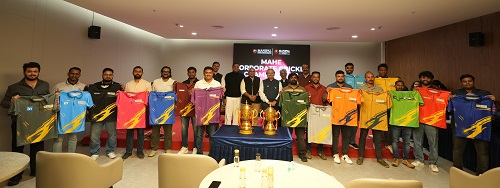

Manipal Academy of Higher Education (MAHE), an Institution of Eminence Deemed to be University, launched the MAHE Corporate Cricket Championship (CCC) 2026 at its Bengaluru Campus on Saturday. Bringing together teams from leading organisations across sectors, the 27-match T20 tournament places industry-academia engagement at its centre, giving corporate professionals and the university community a shared platform to build connections, exchange perspectives and explore opportunities for collaboration through sport.
|
|
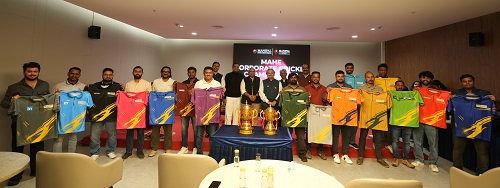
Mr. Avinash V. unveiled the trophy and Dr. Anand V, unveiled the jerseys in the presence of Dr. S. K. Rao, Dr. M. Veeraraghavan,, Dr. R. Prabhu, Dr. Harish Kumar and captains
Chief guest and cricketer Mr. Avinash Vaidya unveiled the championship trophy and Dr. Anand Venugopal, COO, MAHE, unveiled the team jerseys in the presence of Dr. Sharath K. Rao, Vice Chancellor, MAHE, Prof. (Dr.) Madhu Veeraraghavan, Pro Vice Chancellor, MAHE Bengaluru, Dr. Raghavendra Prabhu, Additional Registrar, MAHE Bengaluru Campus, Dr. Harish Kumar S., Director-Corporate Relations, corporate leaders and captains of the participating teams.
Speaking at the launch, Mr. Avinash Vaidya said, “Cricket builds teamwork, discipline, leadership and the ability to perform under pressure, qualities that are equally important in the workplace. By bringing corporate teams together through this championship, MAHE has created a meaningful platform that goes beyond competition to strengthen professional relationships, encourage collaboration and build lasting connections through sport.”
Dr. Sharath K. Rao said, “Institutions and industries grow when they engage with each other consistently and work towards shared goals. The MAHE CCC provides a platform for the corporate community and the university to come together in a spirit of teamwork and collaboration. We hope this engagement will strengthen our existing relationships and lead to meaningful, long-term associations.”
Prof. (Dr.) Madhu Veeraraghavan said, “Corporate leaders across sectors bring different experiences, perspectives and approaches to solving real-world challenges. The CCC creates an informal setting for these perspectives to come together, allowing conversations and ideas to develop beyond conventional boardrooms. For MAHE Bengaluru, the value of this initiative lies in creating a vibrant space where the university and the corporate community can exchange ideas and discover areas of shared interest.”
The championship features teams from prominent organisations across technology, healthcare, consulting and financial services. Participating organisations include ARM, Bosch, Carelon, EY, Google, Hewlett Packard Enterprise, JPMorganChase, KPMG, LinkedIn, Manipal Hospitals, Microland, Microsoft, Novo Nordisk, Salesforce, Thomson Reuters and Unisys.
The championship will follow the T20 white-ball format, with weekend matches scheduled at the MAHE Bengaluru Campus. The teams are divided into four pools, with each team playing three league matches. The tournament will feature 27 matches, including two semi-finals and the final.
The concluding phase will be held at MIT Sports Park, MAHE Manipal. The semi-finals are scheduled for December 5, followed by the final under lights on December 6.
Team and individual performances will be recognised throughout the championship. Awards will be presented to the winner and runner-up, along with honours for Man of the Match in each fixture, Man of the Series, Best Batsman and Best Bowler.
Through the championship, MAHE aims to bring competitive sport and corporate-academic engagement together. The initiative gives corporate professionals, team representatives and the university community an opportunity to build relationships and explore common interests beyond conventional institutional settings.
About Manipal Academy of Higher Education
Manipal Academy of Higher Education (MAHE) is an Institution of Eminence Deemed to be University. MAHE offers over 400 specialisations across Health Sciences (HS), Management, Law, Humanities & Social Sciences (MLHS), and Technology & Science (T&S) streams through its constituent units at campuses in Manipal, Mangalore, Bengaluru, Jamshedpur, and Dubai. With a remarkable track record in academics, state-of-the-art infrastructure, and significant contributions to research, MAHE has earned recognition and acclaim both nationally and internationally. In 2020, the Ministry of Education, Government of India, awarded MAHE the prestigious Institution of Eminence status. Currently ranked 3rd in the National Institutional Ranking Framework (NIRF) 2025 rankings, MAHE is the preferred choice for students seeking transformative learning experience and enriching campus life, as well as for national and multinational corporations seeking top talent.